
Table of Contents
- Why Gold Alternatives Matter for Body Jewelry
- Solid 14K Gold: The Premium Standard for Piercing Jewelry
- Implant-Grade Titanium Piercing Jewelry: Hypoallergenic and Durable
- Safe Metals for Healed Piercings: Material Comparison
- Threadless Gold Piercing Jewelry: Comfort and Convenience
- Where to Buy Quality Body Jewelry Online
- What to Avoid: Gold-Plated and Gold-Colored Alternatives
- Frequently Asked Questions
Last Updated: October 11, 2026
Why Gold Alternatives Matter for Body Jewelry
Choosing the right material for body jewelry is more than an aesthetic decision. Your piercing's health, comfort, and longevity depend on what you wear in it. When you're exploring gold jewelry alternatives piercings options, you're weighing durability, safety, and long-term wearability against cost and style.
The challenge is real: solid gold jewelry offers unmatched quality, but alternatives exist for those seeking different properties or price points. Some materials work brilliantly for healed piercings. Others can trigger reactions even in fully healed placements. Understanding what separates safe metals for healed piercings from materials that belong nowhere near your body is essential before you buy. Expanding your collection beyond standard gold requires careful consideration of biocompatibility, especially when evaluating various lobe piercing jewelry alternatives.
At Pierced and Lovely, we work with clients who've had bad reactions to jewelry before. They ask us the same questions every time: How do I know what's actually safe? What's the difference between plated and solid? And why should I spend more on quality when cheaper options exist? Below, we'll show you exactly what separates gold jewelry alternatives that work from those that don't.
Solid 14K Gold: The Premium Standard for Piercing Jewelry
Solid 14K gold is the benchmark for quality piercing jewelry. It's not the purest form of gold (that would be 24K), but 14K hits the sweet spot: durable enough for daily wear while remaining precious and valuable.

14K gold contains 58.3% pure gold mixed with alloy metals like copper or silver. This composition makes it harder and more resistant to scratching than higher karat weights. For body jewelry that moves, flexes, and endures constant contact with skin, this durability matters. Pierced and Lovely's 14K gold pieces are hallmarked by the UK Birmingham Assay Office, meaning their purity is officially verified. Each piece over 1.0g carries this hallmark as proof of authenticity.
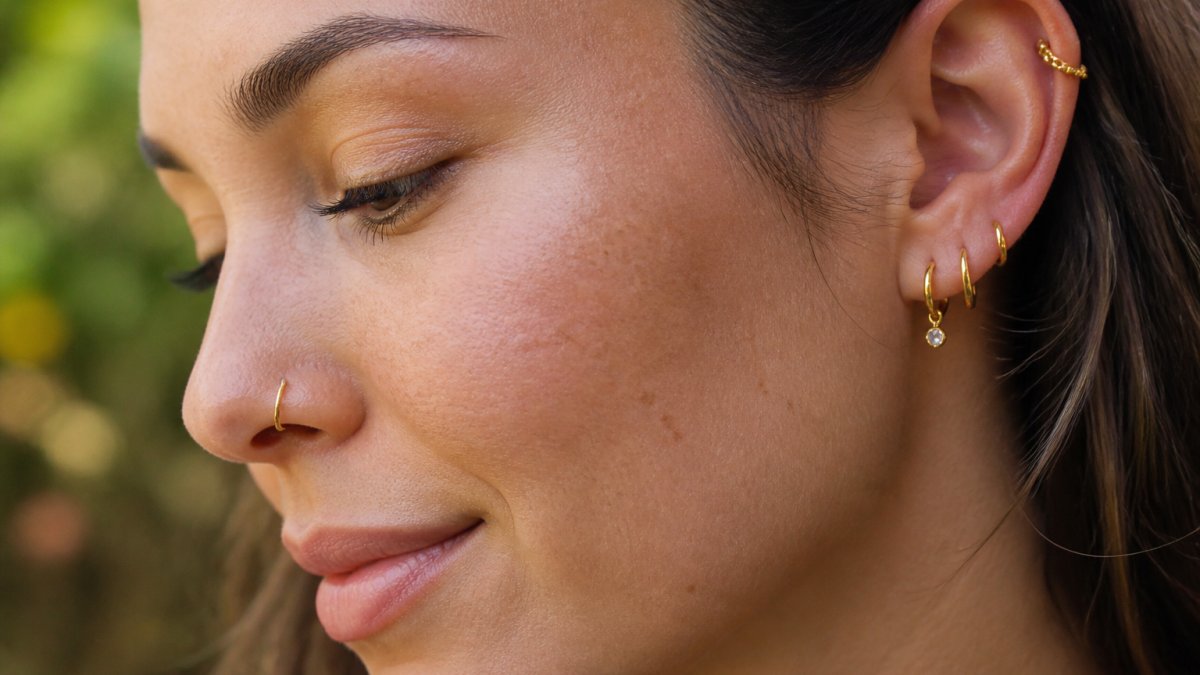
The cost is higher than alternatives, but there's a reason. Solid gold doesn't tarnish, doesn't fade, and won't trigger reactions in healed piercings. It's hypoallergenic by nature because there's no plating to wear away and no base metal to expose. You buy it once, wear it for years, and it only becomes more valuable. Our solid gold hoop rings start at 145.30, while dainty nose rings begin at 52.80.
Implant-Grade Titanium Piercing Jewelry: Hypoallergenic and Durable
Implant-grade titanium represents the best alternative to gold for people with sensitive skin or metal allergies. This isn't ordinary titanium. Implant-grade refers to ASTM F136, a medical-grade standard originally developed for surgical implants.
Titanium is naturally hypoallergenic because it doesn't corrode or release metal ions into your skin. It's lighter than gold, stronger than steel, and won't trigger reactions even in fresh piercings during the healing phase. For those with documented nickel sensitivity, titanium is often the only wearable option besides gold.
The trade-off is aesthetic. Titanium doesn't have gold's warmth or prestige. It reads as silver-toned and modern rather than luxurious. Some people love that look. Others prefer the richness of gold. If you're set on the gold appearance without the gold price, anodized titanium offers a solution, though with caveats we'll cover later.
Titanium's durability rivals gold. It won't tarnish, won't fade, and will last indefinitely with basic care. For healing piercings or sensitive skin, it's the safe metals for healed piercings choice that actually works.
Safe Metals for Healed Piercings: Material Comparison
Once your piercing is fully healed, your options expand. Healed piercings have established tissue that's more forgiving than fresh wounds. Still, not every metal is safe.
| Material | Best For | Durability | Hypoallergenic | Cost |
|---|---|---|---|---|
| Solid 14K Gold | Long-term wear, sensitive skin | Excellent | Yes | Higher |
| Implant-Grade Titanium | Sensitive skin, healing piercings | Excellent | Yes | Medium |
| Sterling Silver | Healed piercings, aesthetic preference | Good | Usually | Medium |
| Niobium | Metal-sensitive individuals | Excellent | Yes | Medium |
| Gold-Plated Jewelry | Budget-conscious, short-term wear | Poor | No | Low |
| Anodized Titanium (gold-tone) | Gold look on budget | Fair | Yes | Low-Medium |
Sterling silver works in healed piercings for most people, though it tarnishes over time and requires regular cleaning. Niobium is another hypoallergenic option, similar to titanium but slightly denser and less common. Both are safer than anything plated or base metal.
The dividing line is clear: if a metal is plated, painted, or anodized to look like gold, it's not the same as solid gold jewelry alternatives for piercings. The coating will wear away. When it does, you're left with whatever base metal is underneath, and that's often where reactions happen.
Threadless Gold Piercing Jewelry: Comfort and Convenience
Threadless jewelry (also called push-fit or click-fit) has revolutionized how people wear body jewelry. Instead of screwing pieces together, threadless designs use tension and precision engineering to hold stones or ends in place.
The benefit is immediate: no twisting, no risk of losing a threaded ball mid-wear, and easier changing. For gold jewelry alternatives piercings in threadless designs, 14K gold offers the same premium quality as traditional threaded pieces with better usability. Pierced and Lovely's 14K white gold septum clicker hoops exemplify this approach, priced at 130.00 and designed for daith, lip, and septum placements.

Threadless systems work best in fully healed piercings where the channel is stable. The pieces stay secure, look seamless, and reduce the fiddling that can irritate even well-healed tissue.
Where to Buy Quality Body Jewelry Online
Not all online retailers are equal. The difference between buying from a boutique maker and a mass-market marketplace matters.
Boutique retailers like Pierced and Lovely maintain quality control at every step. Each piece is handcrafted with attention to detail. Gold is hallmarked by official assay offices. Titanium is verified as implant-grade. Custom orders are fulfilled personally. Delivery times are fast: UK orders ship same-day by first-class post and arrive in 1-3 days. International orders take 3-7 days to most destinations.
Solid Gold 14K Hoop Ring Body Piercing for Ears, Tragus, Helix Ring, Conch →
Mass-market platforms prioritize volume. Quality varies wildly. You might receive plated jewelry labeled as solid. Sizing can be inaccurate. The lowest price often signals the lowest quality.
When buying body jewelry online, ask yourself: Can I contact the seller directly if something's wrong? Does the listing include exact weight and material specifications? Are there customer reviews from verified purchases? At Pierced and Lovely, we answer the same day. Every gold piece lists its weight. Our Etsy reviews average 4.8 out of 5 stars across 3,507 verified purchases.
What to Avoid: Gold-Plated and Gold-Colored Alternatives
Gold-plated jewelry is the false economy of body jewelry. A thin layer of real gold (typically 0.5-2.5 microns thick) sits over a base metal, usually brass, copper, or nickel-plated steel. The plating wears away within months of regular wear, sometimes faster depending on your skin chemistry, sweat exposure, and how often you clean the piece. Once it does, you're wearing the base metal directly against your skin.
This is where reactions happen. Brass tarnishes and can irritate sensitive skin over time. Nickel triggers allergic reactions in roughly 10-15% of the population. Copper oxidizes and can leave green stains on skin. You can't see the base metal until the plating fails. By then, you've already developed a reaction or lost your investment.
Why plating fails faster in body jewelry than other jewelry:
Piercing jewelry experiences constant micro-movement. Every time you touch your piercing, adjust the jewelry, or sleep on it, the plating flexes and cracks at a microscopic level. Sweat and body oils accelerate corrosion of the base metal beneath the coating. Unlike a plated bracelet or necklace that sits statically on skin, piercing jewelry is embedded in tissue and subject to friction from both sides.
Component compatibility issues:
Plated jewelry often uses low-grade posts, backs, and threading. Plated posts are thinner and more prone to bending or breaking than solid metal posts. Plated screw threads wear out faster. If you need to replace a back or post (common for studs and hoops), you'll find that replacement parts for plated jewelry are rarely available, you end up replacing the entire piece.
Gold-colored alternatives: the spectrum of failure:
Gold-colored alternatives span a range of durability:
- Anodized titanium (covered in the previous section) is hypoallergenic but fades within 6-12 months.
- Painted or resin-coated jewelry uses a polymer finish over base metal. The paint chips or peels within weeks to months, especially in piercings where moisture and friction are constant.
- Gold-tone plating is identical to standard gold plating, it fails on the same timeline.
- Vermeil (pronounced "ver-may") is sterling silver coated with a thicker layer of gold (at least 2.5 microns by legal definition). It lasts longer than standard plating, typically 1-2 years with careful wear, but still eventually wears through, exposing silver underneath. Silver tarnishes and requires regular polishing, making vermeil a higher-maintenance option than solid gold.
The honest assessment:
If you want gold jewelry that lasts, you buy solid gold. If you want the gold look on a budget, accept that it will fade, chip, or wear away, and plan to replace it regularly. Anodized titanium is the best budget alternative if you're willing to accept color shift. Vermeil is a middle ground if you don't mind tarnish maintenance. Don't buy standard gold-plated jewelry expecting it to perform like solid gold.
Frequently Asked Questions
What jewelry is safe for healed piercings?
For healed piercings, solid 14K gold, implant-grade titanium (ASTM F136), niobium, and glass are the safest choices. Solid 14K gold is ideal for long-term wear and sensitive skin because it resists corrosion and doesn't degrade. Implant-grade titanium is hypoallergenic and perfect if you have metal allergies. Avoid gold-plated, gold-colored, or anodized alternatives on healed piercings, as the coating wears away and exposes base metals that can irritate skin.
Is 14K gold safe for healed piercings?
Yes, 14K solid gold is one of the safest materials for healed piercings. It contains 58.3% pure gold mixed with alloy metals that strengthen it without compromising biocompatibility. 14K gold resists tarnishing, doesn't corrode, and is ideal for sensitive skin or metal allergies. Ensure any 14K gold piece is hallmarked by a recognized assay office (like the UK Birmingham Assay Office) to verify authenticity. This guarantees the material composition and quality for safe, long-term wear.
What are good alternatives to gold piercing jewelry?
Implant-grade titanium (ASTM F136) is the best alternative to gold for sensitive skin and metal allergies. It's lightweight, durable, and hypoallergenic. Niobium is another hypoallergenic option that's slightly heavier than titanium. Glass retainers work well for temporary wear or concealment at work. Solid silver can work for healed piercings but requires more frequent cleaning. Avoid gold-plated or anodized titanium marketed as gold alternatives, as the coating deteriorates and exposes reactive metals underneath.
How can I tell if body jewelry is made from implant-grade materials?
Legitimate sellers list the specific material grade clearly on product pages. Implant-grade titanium is marked as ASTM F136, not just 'titanium' or 'surgical steel.' Ask sellers for documentation or material certificates if the grade isn't stated. Reputable retailers like Pierced and Lovely provide detailed material specifications and often offer custom orders with confirmed material standards. Be cautious of vague labels like 'hypoallergenic' or 'surgical grade' without specific ASTM certification, these don't guarantee implant-grade quality.
What should I look for when buying gold body jewelry?
Verify the gold purity (14K or higher), check for hallmarking from a recognized assay office, and confirm the exact weight listed. Higher weight means better durability and quality. Look for sellers offering custom orders and fast delivery. Review customer testimonials about fit, color accuracy, and longevity. Ensure the piece is suitable for healed piercings only. Check the gauge and diameter specifications to match your piercing anatomy. Handcrafted pieces from boutique sellers often offer better quality and personalization than mass-produced alternatives.