
Table of Contents
- Quick Comparison: Durable Body Jewelry for Sensitive Skin
- The Best Metal for Sensitive Piercings: Implant-Grade Titanium vs 14k Gold
- Is 14k Gold Safe for Piercings? What You Need to Know
- How to Clean Body Jewelry Without Damaging It
- Top Picks: Durable Body Jewelry for Sensitive Skin from Pierced and Lovely
- How to Verify Metal Composition Before You Buy
- What to Do When a Piercing Becomes Irritated After Changing Jewelry
- Conclusion: Choosing Durable Body Jewelry for Sensitive Skin
- Frequently Asked Questions
Last Updated: October 12, 2026
Quick Comparison: Durable Body Jewelry for Sensitive Skin
If your skin reacts to almost every piece of jewelry you try, the metal is usually the problem. Durable body jewelry for sensitive skin comes down to the alloy touching your piercing: implant-grade titanium and solid 14k gold are the two materials most likely to keep a healed piercing calm for years. At Pierced and Lovely, we build our entire collection around those two metals.
Below, we compare the main options, explain what causes reactions, and show you how to check a metal claim.
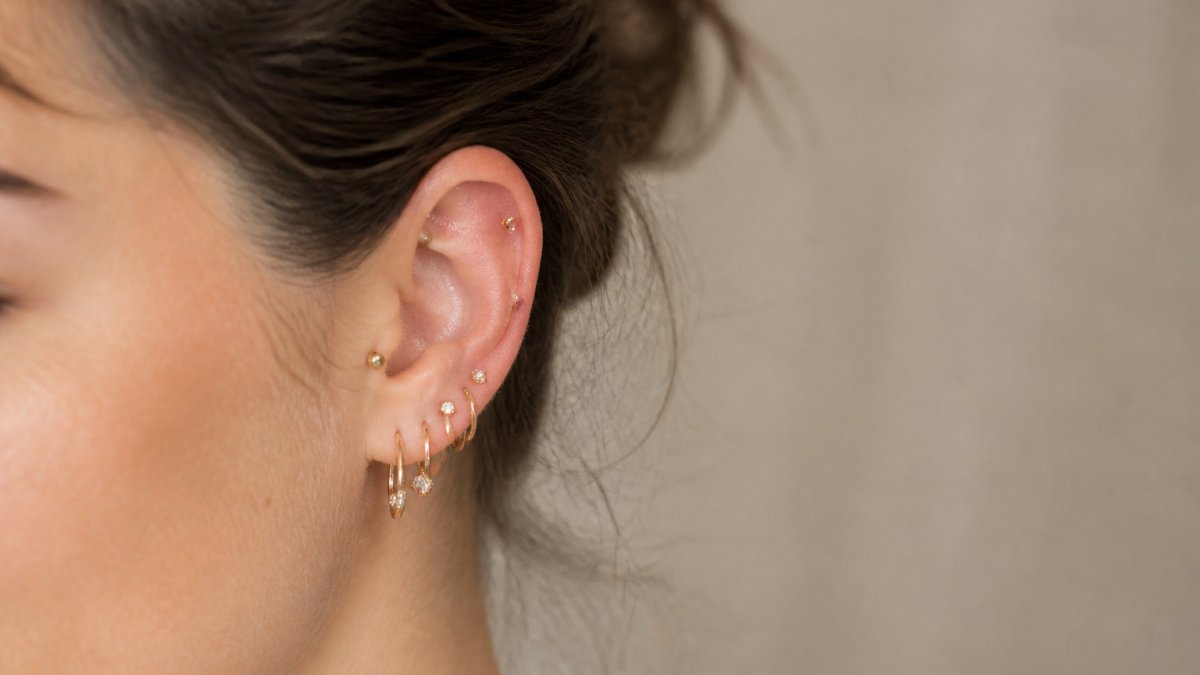
Here is the short version, so you can decide before reading the detail:
| Material | Reaction Risk | Durability | Cost Level | Best For |
|---|---|---|---|---|
| Implant-grade titanium (ASTM F136) | Very low | Excellent | Low to mid | New and healing piercings |
| Solid 14k gold | Low | Excellent | Mid to high | Healed piercings, daily wear |
| Very low | Good | Mid | ||
| Moderate | Fair | Low | ||
| Higher | Good | Low |
The pattern is simple: the cheaper the alloy, the more likely it contains nickel, and nickel is the metal most people react to.
The Best Metal for Sensitive Piercings: Implant-Grade Titanium vs 14k Gold
The best metal for sensitive piercings is implant-grade titanium, specifically ASTM F136, with solid 14k gold the strongest alternative for healed piercings. Titanium wins because it is nickel-free at the level that matters for most reactive skin, and light enough to sit comfortably in cartilage and surface piercings.
ASTM F136 is a standard, not a marketing word (F136 Standard Specification for Wrought Titanium-6Aluminum-4Vanadium ELI (Extra Low...). It describes a specific titanium alloy, Ti-6Al-4V ELI, used in surgical implants, which is why piercers reach for it first when a client has a history of metal sensitivity. The Association of Professional Piercers guidance on jewelry materials treats implant-grade titanium as a default for fresh and healing piercings for this reason.
Why "implant-grade" is not the same as "titanium"
Most sellers use "titanium" loosely. Three grades show up in body jewelry, and only one suits a healing piercing:
- Commercially pure titanium (often Grade 2 or Grade 23). Low nickel content, good for healed piercings, but softer than the alloy used in implants.
- ASTM F136 (Ti-6Al-4V ELI). The implant-grade alloy. Higher strength, tighter composition tolerances, and the grade piercers specify for fresh piercings and surface work.
- ASTM F67 (commercially pure titanium). Also implant-grade, but a different standard used for different applications. It is not interchangeable with F136.
A listing that says "implant-grade titanium" without naming F136 or F67 is unverifiable; one that names the standard is checkable.
How titanium and 14k gold actually hold up
Durability in body jewelry is not one property, it is four, and the two metals behave differently on each:
| Property | ASTM F136 titanium | Solid 14k gold |
|---|---|---|
| Corrosion resistance | Excellent; the oxide layer self-repairs | Excellent; gold is noble and does not oxidise |
| Scratch resistance | Good; harder than pure titanium but can show micro-scratches on polished surfaces | Fair; 14k is softer and polished surfaces dull with daily wear |
| Tarnish | None | None in solid form; plated gold tarnishes once the layer wears through |
| Threading wear | Externally threaded ends can strip if cross-threaded; internally threaded and threadless are more durable | Same threading caveats; gold threads are softer than titanium threads |
That last row matters more than most buyers expect. The most common failure point on body jewelry is not the metal body, it is the threading. A titanium bar with a cross-threaded end is scrap.
Where 14k gold earns its place
Solid 14k gold is an alloy, so it does contain other metals, but at 14k the gold content is high enough that most sensitive wearers tolerate it well once a piercing is fully healed. It also holds up to daily wear without corroding, unlike plated and hollow jewelry.
Two things separate safe gold from risky gold:
- Hallmarking. In the UK, gold items above the legal weight threshold must carry an assay office hallmark (Hallmarking: practical guidance - summary). Our 14k gold is hallmarked in the UK Birmingham Assay Office, so you can confirm the purity rather than trusting a label.
- Gold weight. Genuine sellers list the weight of a piece. A heavier bar means more solid gold and a higher price; if a listing hides the weight, ask before buying.
One honest limitation: because 14k gold is an alloy, a small number of highly nickel-sensitive wearers still react to it. If you are in that group, stay with implant-grade titanium.

For a healing piercing, choose implant-grade titanium. For a healed piercing you want to wear every day, solid 14k gold is the upgrade worth paying for, provided it is hallmarked and the weight is stated.
Is 14k Gold Safe for Piercings? What You Need to Know
Yes, solid 14k gold is safe for piercings for most people, provided it is genuinely solid and the piercing is fully healed. The catch is the word solid. Gold-plated and gold-filled jewelry only carries a thin gold layer over a base metal, and once that layer wears through, the base metal is what your skin meets.
Two things separate safe gold from risky gold:
- Hallmarking. In the UK, gold items above the legal weight threshold must carry an assay office hallmark. Our 14k gold is hallmarked in the UK Birmingham Assay Office, so you can confirm the purity rather than trusting a label.
- Gold weight. Genuine sellers list the weight of a piece. A heavier bar means more solid gold and a higher price; if a listing hides the weight, ask before buying.
One honest limitation: because 14k gold is an alloy, a small number of highly nickel-sensitive wearers still react to it. If you are in that group, stay with implant-grade titanium.
How to Clean Body Jewelry Without Damaging It
Clean your body jewelry with warm water and a mild, fragrance-free liquid soap, then dry it fully with a soft cloth before reinserting.
Titanium Staple Barbell, 16G Surface Piercing Body Jewellery for Anti Eyebrow →
Top Picks: Durable Body Jewelry for Sensitive Skin from Pierced and Lovely
Our top pick for most people is the Titanium Staple Barbell at £24.00, pairing ASTM F136 titanium with a 16g gauge that suits surface piercings like anti-eyebrow, nape, and cleavage placements. It is externally threaded with a custom ball size, comes in 10mm, 12mm, and 14mm lengths, and its low reaction risk makes it a sensible first piece for reactive skin.

For a different fit, the Dermal Surface Piercing 90 Degree Staple Bar starts at £18.99 in implant-grade titanium, available in 16g and 14g, and covers nape, collar bone, cleavage, face, and anti-eyebrow placements.
If you want solid gold, the range steps up in price and in presence. The 14K Solid Gold Curved Barbell at £155.00 suits eyebrow, vertical labret, rook, and cartilage piercings in 18g, 16g, and 14g, with bar lengths from 5mm to 16mm.
Matching the piece to the piercing
Most buying mistakes happen because the style, gauge, or length is wrong for the placement, not the metal. Use this as a starting point, then confirm with your piercer:
| Piercing | Typical starting gauge | Typical length / diameter | Style that works |
|---|---|---|---|
| Nostril | 20g (some 18g) | 6-8mm hoop, or 6-8mm bone/stud | Nose ring, nostril bone stud |
| Septum | 16g (some 14g) | 8-10mm inner diameter | Circular barbell or seamless ring |
| Helix / cartilage | 16g | 6-10mm bar | Flat-back labret, small hoop |
| Eyebrow | 16g | 8-10mm curved bar | Curved barbell |
| Vertical labret | 16g | 8-10mm curved bar | Curved barbell |
| Rook | 16g | 6-8mm curved bar | Curved barbell |
| Nape / surface | 16g (some 14g) | 10-14mm | 90-degree staple bar |
| Anti-eyebrow | 16g | 10-12mm | Staple barbell |
Gauge numbers run backwards: 20g is thinner than 16g, which is thinner than 14g.
| Piece | Material | Starting Price | Best For |
|---|---|---|---|
| Titanium Staple Barbell | ASTM F136 titanium | £24.00 | Surface and dermal piercings |
| Dermal Surface 90 Degree Bar | Implant-grade titanium | £18.99 | Nape, collar bone, anti-eyebrow |
| 14K Solid Gold Curved Barbell | 14k solid gold | £155.00 | Eyebrow, labret, rook, cartilage |
| 14K Solid Gold Nose Ring | 14k solid gold | £52.80 | Nostril, septum, helix |
| 18K Gold Nostril Bone Stud | 18k solid gold | £18.71 | Discreet nostril wear |
Every gold piece over 1.0g carries a UK assay office hallmark, and each listing states the gold weight so you know what you are paying for.
How to Verify Metal Composition Before You Buy
Verifying metal composition means checking three things: the stated standard, the hallmark, and the weight. A listing that names ASTM F136 for titanium, or shows an assay office hallmark for gold, is checkable. One that says only "hypoallergenic" is not.
Run this checklist before you buy:
- Does the listing name a specific standard, such as ASTM F136 for titanium?
- For gold, is there a hallmark from a recognised assay office?
- Is the metal weight stated in grams?
- Does the seller answer questions about composition directly?
- Are custom sizes offered, so the piece actually fits your anatomy?
What to Do When a Piercing Becomes Irritated After Changing Jewelry
If a piercing becomes irritated after a jewelry change, switch back to implant-grade titanium and leave it alone except for saline cleaning. Most irritation settles within a week or two once the trigger is removed. Do not remove jewelry from a healing piercing on your own; see your piercer instead.
The most common causes of post-change irritation are:
- Nickel exposure from a plated or low-grade piece
- Wrong length or gauge, causing movement and friction
- Rough insertion, which scratches the piercing channel
- Over-cleaning with harsh products
Conclusion: Choosing Durable Body Jewelry for Sensitive Skin
Reactive skin does not mean giving up on body jewelry. It means choosing the metal deliberately: implant-grade titanium while a piercing heals, solid hallmarked gold once it has, and a fit that matches your anatomy.
At Pierced and Lovely, every piece is built around those rules. Our 14k gold is hallmarked in the UK Birmingham Assay Office, our titanium meets the ASTM F136 standard, and we take bespoke orders to your exact measurements. Browse the collection and find a piece your skin will tolerate.
Frequently Asked Questions
What is the best body jewelry material for sensitive skin?
Implant-grade titanium (ASTM F136) and solid 14k gold are the safest choices for sensitive skin. Titanium is lightweight, nickel-free, and resists corrosion. Solid gold is inert and unlikely to trigger reactions, but avoid gold-plated or gold-filled pieces because the base metal can contain nickel. Always check that the jewelry is labeled implant-grade or solid gold, not just 'hypoallergenic.'
Is 14k gold safe for piercings?
Yes, solid 14k gold is safe for most people with sensitive skin. It contains 58.5% gold mixed with other metals, but the alloy is stable and does not release nickel in amounts that typically cause reactions. Avoid gold-plated jewelry, as the plating can wear off and expose the base metal. Look for pieces hallmarked by an assay office to confirm authenticity.
How do I know if my jewelry contains nickel?
To check, look for labels like 'nickel-free' or 'implant-grade titanium.' If you have a known allergy, stick to titanium or solid gold from reputable sellers who provide material certifications.
Can sterling silver irritate a piercing?
Sterling silver can irritate piercings because it contains 7.5% copper, which may tarnish and cause skin discoloration. It also scratches easily and can harbor bacteria. For healing piercings, sterling silver is not recommended. For healed piercings, it may be okay for short-term wear, but titanium or gold are better for daily use, especially if you have sensitive skin.
What should I do if my piercing becomes irritated after changing jewelry?
If irritation occurs, switch back to your previous jewelry or a piece made of implant-grade titanium or 14k gold. Clean the area with a sterile saline solution twice a day, and avoid touching it.