
Table of Contents
- How Karat Ratings and Alloys Affect Piercing Safety
- Nickel Allergy Piercing Jewelry: Why 14k Gold Can Still React
- Implant Grade Titanium vs 14k Gold: Which Metal Heals Best?
- Solid Gold vs Gold-Plated: Why Coatings Fail Fresh Piercings
- How to Clean 14k Gold Piercings Without Damaging the Metal
- Choosing Safe 14k Gold Jewelry for Healed Piercings
- Frequently Asked Questions
Last Updated: September 30, 2026
How Karat Ratings and Alloys Affect Piercing Safety
Is a 14k gold safe for piercings? Yes, for most people with healed piercings, a 14k gold safe and durable choice is the norm. The catch is that "14k" describes gold purity, not allergy safety, and the remaining alloy metals determine whether your skin reacts.

14k gold is an alloy made of 58.3% pure gold mixed with other metals, usually copper, silver, zinc, or nickel, to give it strength and a wearable hardness. Pure 24k gold is too soft to hold a piercing securely. That alloy content matters more than the karat number when your skin is sensitive.
14k vs 18k: What the Numbers Mean for Your Skin
Higher karat means more gold and fewer alloy metals, which generally means less reactivity. But 18k is softer and more prone to scratching, so it suits low-traffic placements better than a fresh industrial or helix piercing.
| Karat | Gold Content | Alloy Share | Best For |
|---|---|---|---|
| 14k | 58.3% | ~41.7% | Daily wear, healed piercings, durability |
| 18k | 75% | ~25% | Sensitive skin, low-movement placements |
| 24k | 99.9% | Trace | Display pieces only, too soft for piercing |
At Pierced and Lovely, every piece over 1.0g is hallmarked by the UK Birmingham Assay Office, so you can verify the gold content rather than trusting a label.
Nickel Allergy Piercing Jewelry: Why 14k Gold Can Still React
Nickel is the most common cause of piercing reactions, and it hides inside many 14k gold alloys. Even a piece sold as gold can trigger a reaction if the alloy contains nickel and your skin is sensitized to it.
The mechanism is straightforward: when sweat, skin oils, and cleaning products contact the alloy, they can corrode the surface and release nickel ions. Those ions penetrate the skin and trigger an immune response in sensitized individuals. The more nickel in the alloy and the more acidic your skin environment, the faster this happens. This is why two people can wear the same 14k gold ring with completely different outcomes.
Nickel allergy piercing jewelry is the term you'll see for pieces formulated to exclude or minimize nickel. White gold is the usual offender, since it's often alloyed with nickel and then rhodium-plated. Yellow and rose gold typically use copper and silver instead, making them lower risk. But "typically" is doing heavy lifting there, some manufacturers still use nickel in yellow gold to cut costs, so the color alone is not a guarantee.
How to Verify Nickel Content Before You Buy
The European Union's Nickel Directive (now part of REACH) sets a release rate limit of 0.2 micrograms per square centimeter per week for items in prolonged skin contact, and 0.5 micrograms for piercing posts. This is a public standard, not a marketing claim. If a seller cannot tell you whether their 14k gold meets this threshold, treat the piece as unverified.
A common pattern among reputable jewelers is to disclose the full alloy breakdown, for example, "58.3% gold, 30% copper, 8% silver, 3.7% zinc, 0% nickel." If you have a confirmed nickel allergy, ask for that breakdown in writing before buying. Some brands will provide it; many will not. The ones that do are the ones worth your money.
Signs of Contact Dermatitis and Metal Sensitivity
Contact dermatitis from jewelry shows up as redness, itching, swelling, or a rash confined to the skin touching the metal. Symptoms usually appear within hours to days of wear and clear once the piece is removed. The delay matters: a reaction that appears 48 hours after you put in a new piece is more likely to be nickel sensitization than a simple irritation from friction or moisture.
Watch for these signals:
- Persistent itch or burning under the jewelry
- Dry, flaky, or crusty skin around the piercing
- Small fluid-filled bumps or hives
- Darkening or greenish discoloration of the skin
If irritation continues after removing the piece, see a healthcare professional. A dermatologist can confirm whether nickel or another metal is the trigger. For a definitive answer, ask about patch testing, it's the standard method for identifying metal allergies (the NHS).
Implant Grade Titanium vs 14k Gold: Which Metal Heals Best?
For a fresh piercing, implant-grade titanium wins. It's lighter, nickel-free in the common ASTM F-136 grade, and designed for the healing process. For fully healed piercings, 14k gold is an excellent upgrade once the fistula has closed.

Implant-grade titanium is titanium refined to strict purity standards for medical and piercing use. ASTM F-136 is the specification that governs it, covering the alloy composition used in surgical implants (F136 Standard Specification for Wrought Titanium-6 Aluminum-4 Vanadium ELI (Extra Low...). ISO 5832-3 is the international equivalent.
14K Solid Gold Belly Button Ring - Gold →
ASTM F-136 and ISO Standards Explained
ASTM F-136 and ISO 5832-3 set the composition and cleanliness requirements for titanium used in body jewelry. A piece meeting these standards is verified biocompatible, meaning it won't leach harmful metals into healing tissue.
Solid Gold vs Gold-Plated: Why Coatings Fail Fresh Piercings
Gold-plated jewelry has a thin gold layer over a base metal, often brass or nickel. That coating wears through with friction, sweat, and cleaning, exposing the reactive core underneath. On a healing piercing, that exposure can cause irritation and set back recovery. Maintaining a pristine environment around the jewelry is essential to prevent these reactions, which is why incorporating consistent piercing aftercare tips remains the most effective way to support long-term tissue health.
The failure mechanism is worth understanding. Traditional electroplating deposits gold onto a base metal through an electrical current. The bond is mechanical, not metallurgical, meaning the gold layer sits on top of the base rather than fusing with it. Over time, moisture and sweat seep into microscopic gaps at the edges of the plating. Once that happens, the base metal begins to corrode, and the gold layer starts to flake or delaminate. In a fresh piercing, where the fistula is an open wound, that exposed base metal, often nickel or brass, sits directly against healing tissue.
Solid 14k gold is gold all the way through, so there's no coating to flake or wear away. It costs more because the material itself is gold, not a veneer over cheap metal. The trade-off is durability: a solid 14k gold piece can last decades with proper care, while a plated piece may show wear within months.
PVD Coating vs Traditional Plating
PVD (physical vapor deposition) coating bonds a gold-colored layer more tightly than electroplating, so it lasts longer. In PVD, gold is vaporized in a vacuum chamber and deposited onto the base metal at a molecular level. The resulting bond is stronger and more resistant to corrosion than electroplating. It still isn't solid gold, and it can still wear at high-friction points like a septum or helix. For a fresh piercing, neither coating is a substitute for solid gold or implant-grade titanium.
The practical distinction: PVD is better than traditional plating, but both are coatings.
How to Clean 14k Gold Piercings Without Damaging the Metal
Clean 14k gold with warm water, a mild fragrance-free soap, and a soft-bristled brush, then pat dry with a lint-free cloth. Avoid harsh chemicals, chlorine, and abrasive polishes, which strip the finish and can dull the alloy.

A simple routine:
- Wash hands thoroughly before touching the jewelry.
- Soak the piece in warm water with a drop of mild soap for a few minutes.
- Gently brush around settings and hinges with a soft brush.
- Rinse under warm running water.
- Pat dry and buff lightly with a soft cloth.
Choosing Safe 14k Gold Jewelry for Healed Piercings
Buy solid 14k gold from a seller who discloses the alloy content, the weight, and the hallmark. Solid gold is the safest long-term choice for healed piercings, provided the alloy is low in nickel and the piece is genuinely solid rather than plated.
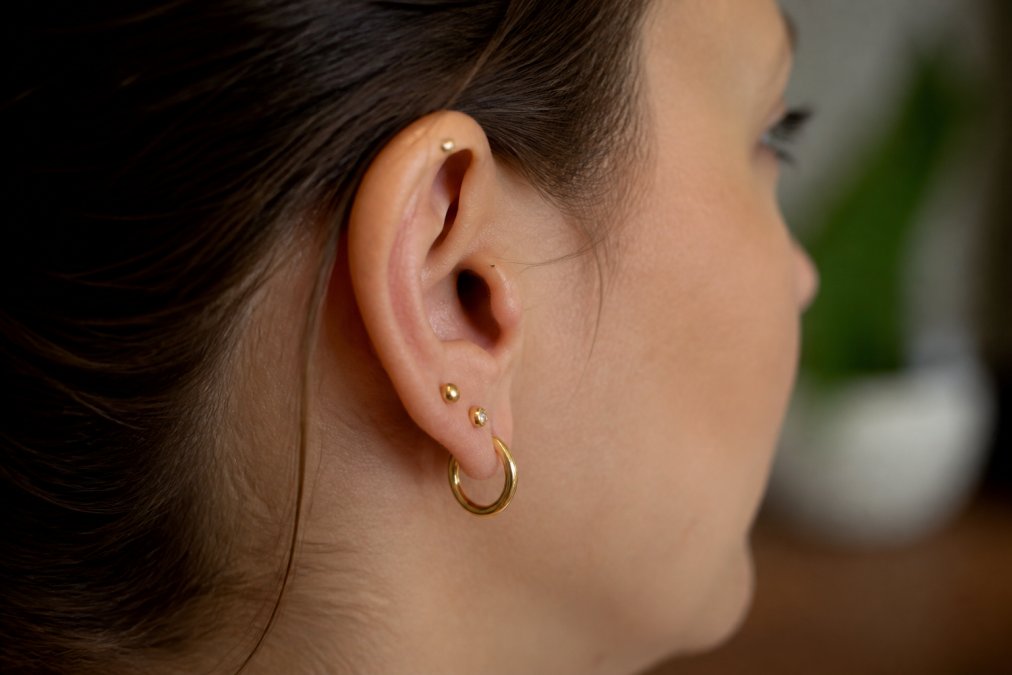
Checklist before you buy:
- Confirm the piece is solid 14k gold, not plated or filled
- Ask for the alloy metals (look for low or no nickel)
- Verify a hallmark for pieces over 1.0g
- Match the gauge and length to your healed piercing
- Check the return policy for sizing issues
Frequently Asked Questions
How long will 14k gold last in a piercing?
Solid 14k gold is durable enough to last decades with proper care. Unlike plated jewelry that flakes over months, solid gold keeps its structure because the metal is consistent throughout. It can scratch or lose polish over years of daily wear, but a professional polish restores the finish. Store pieces separately to prevent surface scratches, and clean regularly to maintain shine.
Is 14k gold better than 18k gold for body piercings?
For most people, 14k gold offers a better balance. It contains 58.5% gold mixed with harder alloys, making it more scratch-resistant for daily wear. 18k gold has 75% gold and is softer, so it dents more easily in cartilage piercings. However, 18k gold contains less nickel overall, which may suit very reactive skin. The right choice depends on your sensitivity level and where the piercing sits.
Can I shower with 14k gold piercing jewelry?
Yes, solid 14k gold handles showering without damage. Water alone will not corrode or tarnish it. The concern is soap, shampoo, and conditioner residue building up around the piercing, which can cause irritation. Rinse the area thoroughly after showering and dry gently with a clean cloth. Skip harsh exfoliants near the piercing site.
What are the disadvantages of 14k gold for piercings?
The main drawbacks are cost and nickel content. Solid 14k gold costs more than titanium or surgical steel because gold is expensive. The alloy mix in 14k gold typically includes nickel, so people with a diagnosed nickel allergy may still react. It is also softer than titanium, meaning it scratches more easily. For fresh piercings, implant-grade titanium is usually the safer starting option.