
Table of Contents
- Is Implant Grade Titanium Nickel Free?
- What Is Implant Grade Titanium and ASTM F136 Standards
- ASTM F-136 Titanium vs Surgical Steel: Why the Difference Matters
- Trace Elements in Titanium Alloys: The Nickel Question
- Symptoms of Nickel Allergy From Jewelry and When to Switch Materials
- Is 14k Gold Safe for Piercings and How It Compares to Titanium
- How to Identify Authentic Implant Grade Titanium and Avoid Counterfeits
- Frequently Asked Questions
Last Updated: September 27, 2026
Is Implant Grade Titanium Nickel Free?
When you're choosing body jewelry, the material matters more than most people realize, which is why implant grade titanium nickel free options are essential for sensitive skin. If you've experienced itching, rashes, or discoloration around a piercing, metal sensitivity could be the culprit. At Pierced and Lovely, we address common concerns about metal sensitivity, and the question we hear most often is whether implant-grade titanium is truly nickel-free.
The short answer: implant-grade titanium certified to ASTM F136 standards is designed to be nickel-free. But the reality is more nuanced. Some titanium alloys contain trace amounts of nickel, and understanding the difference between what's marketed and what's actually in your jewelry can save you from another painful reaction.
Below, we'll walk you through exactly what implant-grade titanium is, how it differs from other materials, what trace elements actually mean, and how to identify the real deal when you're shopping online.
What Is Implant Grade Titanium and ASTM F136 Standards
Implant-grade titanium is a specific classification of titanium alloy engineered for biocompatibility with the human body. It's not just any titanium, it's titanium that meets strict international standards for medical and body jewelry use.
The most common implant-grade titanium you'll encounter is either commercially pure titanium (CP Titanium) or a titanium-aluminum-vanadium alloy (Ti-6Al-4V ELI). Both are hypoallergenic materials designed to minimize allergic reactions and corrosion resistance in the body.

The ASTM F136 certification explained
ASTM F136 is the American Society for Testing and Materials standard that defines what qualifies as implant-grade titanium. This certification is the gold standard for body jewelry safety. When a piece carries ASTM F136 certification, it means the material has been tested and verified to contain minimal trace elements and no intentional nickel content.
The standard sets strict limits on what elements can be present in the alloy. Iron, oxygen, nitrogen, and carbon are controlled to specific percentages. Nickel is not an intentional component of ASTM F136 titanium, but trace amounts may occur during manufacturing, typically less than 0.03%.
Our titanium pieces at Pierced and Lovely are tested to meet strict regulations for being free of nickel, cadmium, and lead by Sheffield Assay Office in England. This third-party verification gives you confidence that what you're wearing has actually been tested.
CP Titanium vs Ti-6Al-4V: Which is truly nickel-free
The two main types of implant-grade titanium differ in composition and how they perform.
CP Titanium (commercially pure titanium, grades 1-4) is the purest form of implant-grade titanium. It contains 98-99% titanium with minimal alloying elements. CP Titanium is naturally hypoallergenic and non-reactive, making it a suitable choice for people with sensitive skin or known metal allergies. It's softer than Ti-6Al-4V, which means it's easier to work with for custom pieces but slightly more prone to scratching.
Ti-6Al-4V ELI (titanium-aluminum-vanadium, extra-low interstitial) is a stronger alloy containing 6% aluminum and 4% vanadium.
ASTM F-136 Titanium vs Surgical Steel: Why the Difference Matters
Surgical steel and implant-grade titanium sound similar, but they're fundamentally different materials with very different safety profiles.
Trace Elements in Titanium Alloys: The Nickel Question
This is where the nuance matters. Even ASTM F136 titanium can contain trace amounts of nickel, and understanding why, and how to verify it, helps you make an informed choice backed by science rather than marketing claims.
How trace nickel enters the alloy
During manufacturing, titanium is processed through multiple stages. Raw materials are melted, refined, and cast into ingots. At each step, there's potential for trace element contamination. Nickel can enter through the raw materials themselves, through equipment used in processing, or through recycled scrap metal mixed into new batches.
Testing protocols that verify nickel content
Several testing methods can measure nickel in titanium alloys, but not all are equally reliable for body jewelry applications.
Titanium Black Spike Septum Nose Ring →
Understanding test reports and what the numbers mean
A legitimate test report should include:
- Material composition (e.g., "CP Titanium, Grade 1" or "Ti-6Al-4V ELI")
- Nickel concentration in ppm or percentage (e.g., "<10 ppm nickel" or "0.001%")
- Testing method (ICP-MS, XRF, or AAS)
- Accreditation of the lab (ISO 17025 or equivalent)
- Date tested and batch or lot number
If a report just says "ASTM F136 compliant" without numbers, it's incomplete. The numbers tell you how much margin you have. A piece with <10 ppm nickel is safer for severe sensitivity than one at 250 ppm, even though both meet the 300 ppm standard.
Why CP Titanium and Ti-6Al-4V ELI differ in trace element profiles
Commercially pure titanium (CP Titanium, Grades 1-4) naturally has lower trace nickel because it's not alloyed, there's less opportunity for contamination during the alloying process. CP Titanium typically tests at <5 ppm nickel.
Symptoms of Nickel Allergy From Jewelry and When to Switch Materials
If you're experiencing symptoms after wearing jewelry, it helps to know whether it's a nickel reaction or something else.
Is 14k Gold Safe for Piercings and How It Compares to Titanium
Gold is another option for people with metal sensitivity, and it's worth understanding how it stacks up against titanium.
| Material | Nickel Content | Biocompatibility | Durability | Cost |
|---|---|---|---|---|
| ASTM F136 Titanium | 0% intentional, <0.03% trace | Excellent | High | Moderate |
| 14k Gold (nickel-free verified) | 0% | Excellent | Very High | High |
| Surgical Steel | 8-12% | Poor for sensitive skin | High | Low |
| CP Titanium | 0% | Excellent | Moderate | Moderate |
How to Identify Authentic Implant Grade Titanium and Avoid Counterfeits
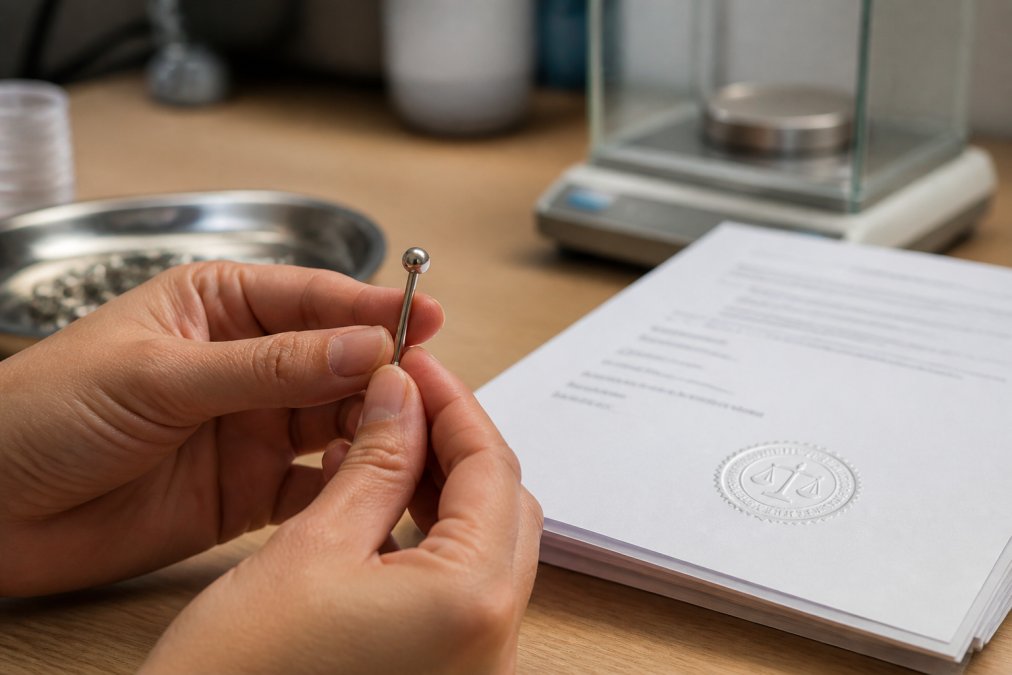
Online shopping for body jewelry carries a real risk: counterfeits, mislabeled products, and sellers who claim ASTM F136 certification without verification. Buyers have no way to check until they wear the piece and experience a reaction. Here's how to verify you're getting authentic implant-grade titanium, and spot fakes before you buy.
Red flags at the point of purchase
Vague material descriptions. Authentic sellers specify the exact material: "CP Titanium, ASTM F136" or "Ti-6Al-4V ELI, ASTM F136." Counterfeits use fuzzy language: "hypoallergenic titanium," "medical-grade titanium," "titanium alloy," or just "titanium." These terms are marketing shortcuts with no legal definition. ASTM F136 is the specific standard that matters; if it's not mentioned, assume the material is unverified.
Technical red flags: What to look for in the actual piece
Threading location and quality. For initial piercings, authentic implant-grade titanium is almost always internally threaded (the threading is on the wearable end that screws into the post, not on the part that goes through the piercing). Internal threading is more expensive to manufacture because it requires precision machining. Counterfeits often use externally threaded pieces because they're cheaper to produce.
Verification checklist before you buy
- Does the product description specify ASTM F136? (Not just "titanium" or "hypoallergenic")
- Can you access a test report or certificate? (Ask the seller; legitimate ones provide it)
- Is the piece internally threaded for initial piercings? (If it's for a fresh piercing)
- Does the seller name the material source or supplier? (Or at least the country of origin)
- Is the price in the $12-$30 range for a basic piece? (Adjust for size and design)
- Does the threading feel smooth and precise? (If you can inspect before purchase)
- Does the seller respond to verification questions within 24 hours? (Legitimate makers do)
- Is there a return or satisfaction guarantee? (Reputable sellers stand behind their claims)
If a seller can't answer yes to at least 5 of these, the piece is likely counterfeit or unverified.
Where to buy with confidence
Buy from sellers who specialize in body jewelry and have verifiable credentials. Pierced and Lovely sources all titanium from accredited suppliers, tests every batch through Sheffield Assay Office, and provides test documentation with each piece. We also offer a satisfaction guarantee: if a piece doesn't fit or meet your needs, we work with you to make it right.
What to do if you suspect a counterfeit
If you've purchased a piece labeled ASTM F136 and suspect it's counterfeit, you have options:
- Request a refund based on misrepresentation. If the seller claimed ASTM F136 but can't provide proof, you have grounds for a return.
- Report the seller to the marketplace or payment processor for false advertising.
- Have the piece tested independently. Some assay offices offer testing services for consumers. If the piece tests outside ASTM F136 standards, you have documentation to support a dispute.
Frequently Asked Questions
Is implant grade titanium completely nickel free?
Implant grade titanium certified to ASTM F136 contains less than 0.03% nickel by weight, which is considered trace amounts. This level is hypoallergenic for most people with nickel sensitivity because the nickel is locked within the alloy structure and does not leach into the body. However, individuals with severe nickel allergies should consult a dermatologist before wearing any titanium jewelry, as extremely sensitive individuals may still react to trace elements.
What does ASTM F136 mean for body jewelry?
ASTM F136 is an international standard that defines the composition and purity requirements for implant-grade titanium used in medical devices and body jewelry. It specifies strict limits on nickel, cadmium, lead, and other trace elements. Jewelry certified to this standard has been tested by accredited assay offices and meets biocompatibility requirements, making it safe for initial piercings and sensitive skin. Pierced and Lovely's titanium pieces are tested by the Sheffield Assay Office to confirm they meet these regulations.
Can I be allergic to implant grade titanium?
True allergies to implant-grade titanium are extremely rare because the alloy is biocompatible and non-reactive in the body. However, some people may experience sensitivity if they have contact dermatitis from contaminants on the jewelry surface, or if they are allergic to the trace elements present (such as vanadium in Ti-6Al-4V alloys). If you suspect a reaction, remove the jewelry, clean it thoroughly, and consult a dermatologist to determine whether it's a true allergy or irritation from another cause.
How do I know if my titanium jewelry is actually implant grade?
Authentic implant-grade titanium should come with documentation showing ASTM F136 certification and testing results from an accredited assay office. Pierced and Lovely's titanium pieces are tested by the Sheffield Assay Office in England and confirmed free of nickel, cadmium, and lead. Check for certification marks, ask the seller for test results, and avoid sellers who cannot provide documentation. If a piece is suspiciously cheap or lacks any certification information, it is likely not genuine implant-grade titanium.