
Quick Summary
Custom belly button rings are sized by two measurements: gauge, the bar thickness, and bar length, the distance between the two ends. Most navel piercings use 14 gauge, and standard lengths are 8mm, 10mm and 12mm. To find a custom length, measure your piercing or an existing ring that fits well, then order the closest match.
- Most navel piercings are done at 14 gauge, which measures about 1.6 mm.
- Standard belly rings come in 8mm, 10mm and 12mm bar lengths.
- Measure the straight bar between the ball ends, not the decorative top.
- Take the measurement twice and use the middle figure if readings differ.
- Avoid measuring a fresh, swollen piercing, since it may read longer than it will once healed.
Table of Contents
- How Belly Button Ring Sizes Work: Gauge and Bar Length
- Belly Button Ring Size Chart: 8mm to 12mm at a Glance
- 10mm vs 12mm Belly Button Ring: Choosing the Right Length
- Custom Length Belly Button Rings: Measuring Your Piercing
- Longer Belly Button Rings While a Piercing Heals
- Materials, Personalization and Custom Orders
- Ordering Your Custom Size from Pierced and Lovely
- Frequently Asked Questions
How Belly Button Ring Sizes Work: Gauge and Bar Length
Last Updated: November 22, 2026
Belly button ring sizing comes down to two numbers: gauge and bar length. Knowing what each of these two measurements means helps you choose the right piece before you order. Custom belly button rings in different sizes start with understanding how these specifications work together, so the fit you choose is the one you actually need.
Gauge describes the thickness of the bar that passes through your skin. Bar length describes the distance between the two ends of the ring. Get both right, and the jewelry sits comfortably. Get one wrong, and it may press, shift, or irritate your piercing.
Standard 14G Gauge and Fit
Most navel piercings are done at 14 gauge, which measures about 1.6 mm. The listed belly rings use this gauge. If you are unsure of your gauge, ask your piercer before ordering.
Standard belly rings are described with a 14G (1.6mm) bar and lengths of 8mm, 10mm and 12mm. A 10mm bar is a common starting point for many wearers, but fit varies from person to person, so the listed length is not a guarantee.
What Bar Length Actually Measures
Bar length is the distance between the two ends of the barbell, not the length of the jewelry's decoration. Measured correctly, it tells you how much room the ring has inside the navel. Too short and the ends can press against the skin. Too long and the ring may swing or catch on clothing.
Belly Button Ring Size Chart: 8mm to 12mm at a Glance
Belly button rings are listed in three lengths: 8mm, 10mm and 12mm, all in 14G. Use the chart below as a quick reference, then read the measurement notes underneath so you are not guessing from the table alone. Your piercer can confirm the right length for your anatomy.
| Bar Length | Gauge | Typical Fit | Best For |
|---|---|---|---|
| 8mm | 14G (1.6mm) | Shallow navels | Tighter, close-fitting wear |
| 10mm | 14G (1.6mm) | Most standard navels | Everyday wear |
| 12mm | 14G (1.6mm) | Deeper navels or swelling | Extra room, longer healing |
A size chart is only a starting point because it cannot see your anatomy. Two people can both wear a 10mm bar and still need different lengths if one has a shallow navel and the other has thicker tissue or a deeper fold. That is why the chart should be paired with a real measurement rather than treated as a universal answer.
How to Measure an Existing Ring
If you already wear a belly ring that fits well, the most reliable way to find your size is to measure that ring rather than your body. Remove the jewelry, lay it flat on a ruler, and measure the straight bar between the two ball ends, not the decorative top or the curve of a curved barbell. Record the figure in millimetres. A ring that measures close to 10mm between the ends is a 10mm bar; one closer to 12mm is a 12mm bar.
For a curved barbell, measure along the curve from one end to the other with a soft tape or a piece of string, then lay the string against a ruler. Do not measure the drop of a dangle or the width of a gem, those are decoration measurements, not bar length.
How to Measure Your Piercing
If you do not have a well-fitting ring to copy, measure the piercing itself. Wash your hands, stand in front of a mirror in soft light, and hold a thin measuring tape or a strip of paper against the skin. Measure the distance from the top hole to the bottom hole, following the line the jewelry would take. Keep the tape gently against the skin without pressing in, and measure with your body relaxed rather than sucking in or bending.
Take the measurement twice and write both numbers down. If the two readings differ, take a third and use the middle figure. Round to the nearest listed length if you are choosing from our 8mm, 10mm and 12mm options, or send the exact figure when requesting a custom order.
Matching Size to Anatomy and Piercing Placement
A healed piercing and a fresh piercing do not need the same length. A fresh piercing often swells in the first weeks, so a piercer may fit a slightly longer bar to leave room for that change. A healed piercing usually settles into a shorter, closer-fitting length once swelling has gone down.
A common pattern is that people with a shallow navel do well with 8mm, most standard navels start around 10mm, and deeper navels or those still settling may need 12mm. These are starting points, not rules. If your anatomy is unusual, or if you have had the piercing for years and it has changed shape, a custom length is usually more comfortable than forcing a standard size.
Watch out: do not measure a fresh, swollen piercing and order a final length from that number, swelling can make the piercing measure longer than it will once healed, and a bar ordered to that figure may end up too long.
Browse the 10mm 14G clicker belly bar with CZ crystal if you want a standard-length option to compare against the chart.
10mm vs 12mm Belly Button Ring: Choosing the Right Length
The choice between 10mm and 12mm usually depends on how much room your navel has and whether the piercing is still healing. A 10mm bar suits most people with a settled piercing. A 12mm bar gives more space, which can help if your navel is deeper or the area is swollen.
Longer is not always better. An overly long bar can move around, snag clothing, and sit awkwardly. If you are unsure, start with 10mm and check the fit after a few days of wear.
Shoppers comparing lengths often want a curved option to match the listed dimensions. See the 10mm curved barbell in oval crystal design for a concrete example of a 10mm piece.
Custom Length Belly Button Rings: Measuring Your Piercing
Custom sizing can make sense when standard sizes do not fit well. Once you know your measurement, you can shop belly bars in the length you need. This is common with unusual anatomy, a piercing that has changed shape over time, or a navel that sits between two listed lengths. Measuring your piercing first gives you the information needed for a precise order, and it also tells you whether a custom length is really necessary or whether a standard 8mm, 10mm or 12mm bar will do.
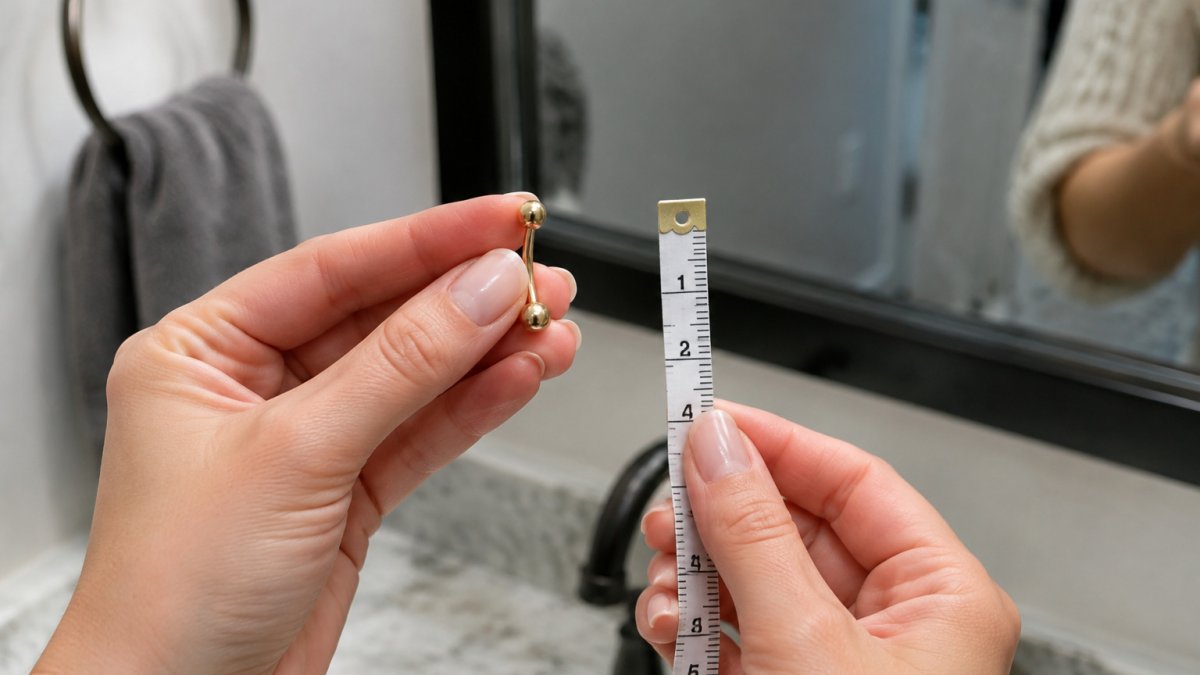
!Close-up of hands holding a thin measuring tape and a gold belly bar beside a bathroom mirror, soft natural light
How to Measure for a Custom Length
Measure the distance across your navel from one piercing hole to the other, with the tape held gently against the skin. Record the number in millimetres. Round to the nearest standard length if you are choosing from our listed options, or send the exact figure when requesting a custom order.
Measure when your skin is relaxed, not when you are sucking in or bending. Take the measurement twice and write it down. If you have a well-fitting ring already, measure that ring instead, lay it flat and measure the straight bar between the ends, ignoring the decorative top. Comparing the two figures, your body measurement and your existing ring, is a useful cross-check: if they disagree by more than a millimetre or two, measure again before ordering.
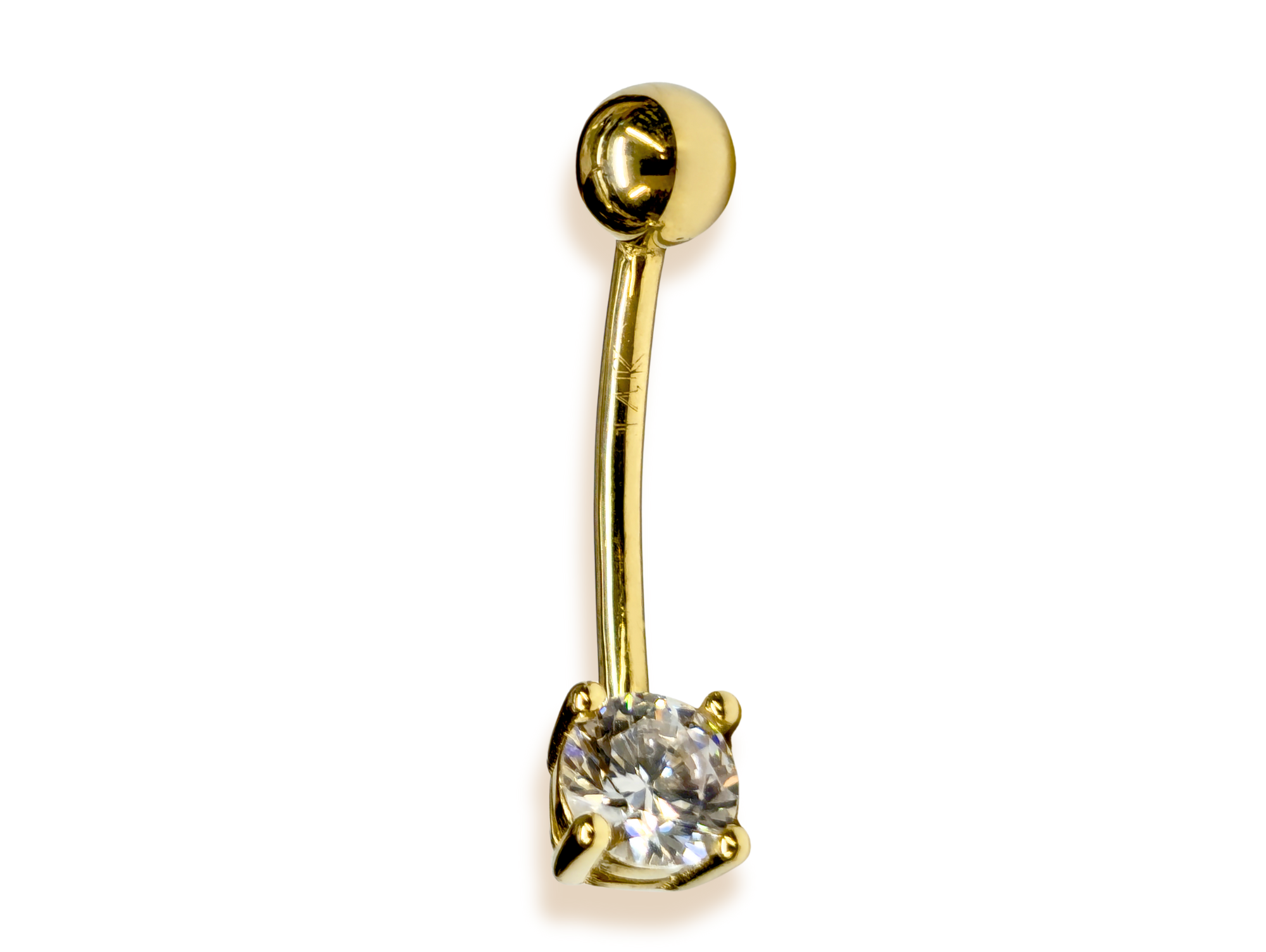
Once you know your number, you can shop the 14K solid gold belly button ring with fixed bottom hollow ball in the length closest to your measurement.
Fit Checks and Sizing Troubleshooting
After fitting, check that the ring sits flat, does not press on the skin, and does not move excessively. If it feels tight, it may be too short. If it catches on clothing or hangs away from the navel, it may be too long.
A few concrete signs help you judge fit. A bar that is too short may leave a red mark or indentation at either hole, feel tender after a few hours, or make the skin around the piercing look puckered. A bar that is too long may rotate freely, snag on waistbands, sit at an angle rather than flat, or let the top ball catch when you bend.
Watch out: never force a ring into a piercing that has not healed. Forcing it can cause tears and irritation, and a bar that is too short on a healing piercing can press on swollen tissue and delay healing.
If you are between sizes, a common approach is to choose the shorter length for a settled piercing and the longer length only when a piercer has confirmed you need room for swelling or deeper anatomy.
Longer Belly Button Rings While a Piercing Heals
A healing piercing often swells, so some wearers prefer a slightly longer bar during the early weeks. A longer length gives the tissue room to change without pressing on the jewelry.
Only wear jewelry designed for healed piercings once the navel has fully settled. Our listings state that the body jewelry is suitable for healed piercings only. If your piercing is still healing, speak to your piercer before choosing a size.
Materials, Personalization and Custom Orders
The 14K gold jewelry is hallmarked in the UK Birmingham Assay Office. Each listing states its material, so check the product details before buying.
Bespoke gold jewelry orders are available. Gold weight matters for price, and each product page lists its weight.
If you have sensitive skin, look at the material listed for each piece and speak to your piercer about your sensitivities.
Ordering Your Custom Size from Pierced and Lovely
To order a bespoke gold piece, message us with your specifications.
Fast delivery options are available.
Contact us about any problem with your order. Ready to choose your size? View products today.
Frequently Asked Questions
Do belly button rings come in different sizes?
Yes. Belly button rings vary in gauge and bar length. The standard navel gauge is 14G (1.6mm), and common bar lengths include 8mm, 10mm and 12mm. Pierced and Lovely offers its 14G belly bars in 8mm to 12mm lengths. Because piercings differ in depth and placement, the best length is the one that sits comfortably against your skin without pressing or pulling. If you are unsure, message the shop with your current size or measurement before ordering.
What is the difference between a 10mm and a 12mm belly button ring?
A 12mm belly bar is 2mm longer than a 10mm bar, which gives more room between the two ends. A 10mm bar suits most standard navel piercings and sits closer to the skin. A 12mm bar is often better for people with a fuller abdomen or a piercing that sits deeper, because it avoids tightness. Choose based on how the current bar sits, and remember that the 14G gauge stays the same across these lengths.
Can you get a custom length belly button ring?
Yes. Pierced and Lovely's 14K solid gold belly bars are crafted in-house and can be made to custom specifications. Message the shop with your required length, gauge and design, and it will respond the same day. Custom gold pieces are made to order, so check the timing before you need the jewelry. Since body jewellery is generally not returnable, confirm your measurement carefully before placing a custom order.
Can you wear a longer belly button ring while a navel piercing is healing?
Jewelry should only be changed on a fully healed piercing. The Pierced and Lovely range is designed for healed piercings only. A longer bar can rest more comfortably if your abdomen is swollen or you are pregnant, but healing piercings need the correct, stable size to avoid irritation. Ask a piercer before changing the length during healing, and do not force a bar into a piercing that is still tender.
