
Quick Summary
Hoop earrings alternatives for a stack include helix barbells, huggies, cartilage studs, dangles and ear cuffs. A helix barbell is the top pick because it anchors the look and sits close to the ear, so it snags less than a dangle or large hoop.
- Rank helix barbells first for a stack because they sit close to the ear and hold a fixed position.
- Measure huggie inner diameter against your ear thickness, and size up if you are between sizes.
- Cluster three or more cartilage studs so they read as a stack rather than a single small point.
- Use only one dangle as a focal point and keep the pieces above and below it flat.
- Only build a stack on fully healed piercings, and add one new piece at a time.
Table of Contents
- Why Build an Ear Stack Without Hoops
- Ranking the Best Non-Hoop Options for a Stack
- Earrings to Stack With Studs
- Huggie Earrings for Stacks: Placement and Fit
- Earring Stack Ideas Built Around a Focal Piece
- Earrings for Sensitive Ears: Materials, Comfort and Care
- Building Your First Stack From Pierced and Lovely Pieces
- Frequently Asked Questions
Why Build an Ear Stack Without Hoops
Hoops are the default for an ear stack, but they are not the only option, and hoop earrings alternatives such as studs, huggies, cuffs and drop pieces can look more curated and often suit piercings that a large hoop would sit awkwardly on. Styling advice commonly suggests pairing a focal piece with smaller, quieter companions and varying the size as you move up the ear.
Stacking without hoops also gives you more control over fit. A small stud or a barbell can sit exactly where your cartilage allows, while a large hoop may catch on clothing or pull against a healing piercing. For a first stack, that flexibility matters more than any single trend.
Ranking the Best Non-Hoop Options for a Stack
Here is how we would rank the main non-hoop options for building a stack, based on versatility, ease of wear, and how well each piece holds its place across different piercings. The ranking assumes fully healed piercings; if you are still healing, stick with the jewellery your piercer fitted and do not swap pieces yet.
| Rank | Option | Best placement | Best for | Watch for |
|---|---|---|---|---|
| 1 | Helix barbells | Helix, upper ear, flat | Building height and rhythm without snagging | Must be fully healed before changing; check ball size so it does not sit too proud |
| 2 | Huggies | Lobe, lower cartilage | A soft, rounded base layer that follows the ear curve | Inner diameter must match your ear thickness or the huggie will pinch or hang loose |
| 3 | Cartilage studs | Helix, tragus, conch | Small, everyday accents that sit flat under hair and hats | Limited visual weight alone; cluster three or more to read as a stack |
| 4 | Dangle earrings | Upper ear, lobe | A movement-led focal point that catches light | Can snag on hair, scarves, and towel loops; best kept for healed piercings and low-friction days |
| 5 | Ear cuffs and climbers | Helix rim, mid-ear | Adding a stacked look without a new piercing | Fit depends on ear shape; a loose cuff can slide off and a tight one can pinch |
Our top pick for a stack is a helix barbell, because it anchors the look without needing a second piece to balance it. A barbell sits close to the ear, so it does not catch on clothing the way a dangle or a large hoop can, and it holds a fixed position on the ear so your spacing stays even. Pair it with a smaller stud below and you have a complete arrangement that reads as intentional rather than crowded.
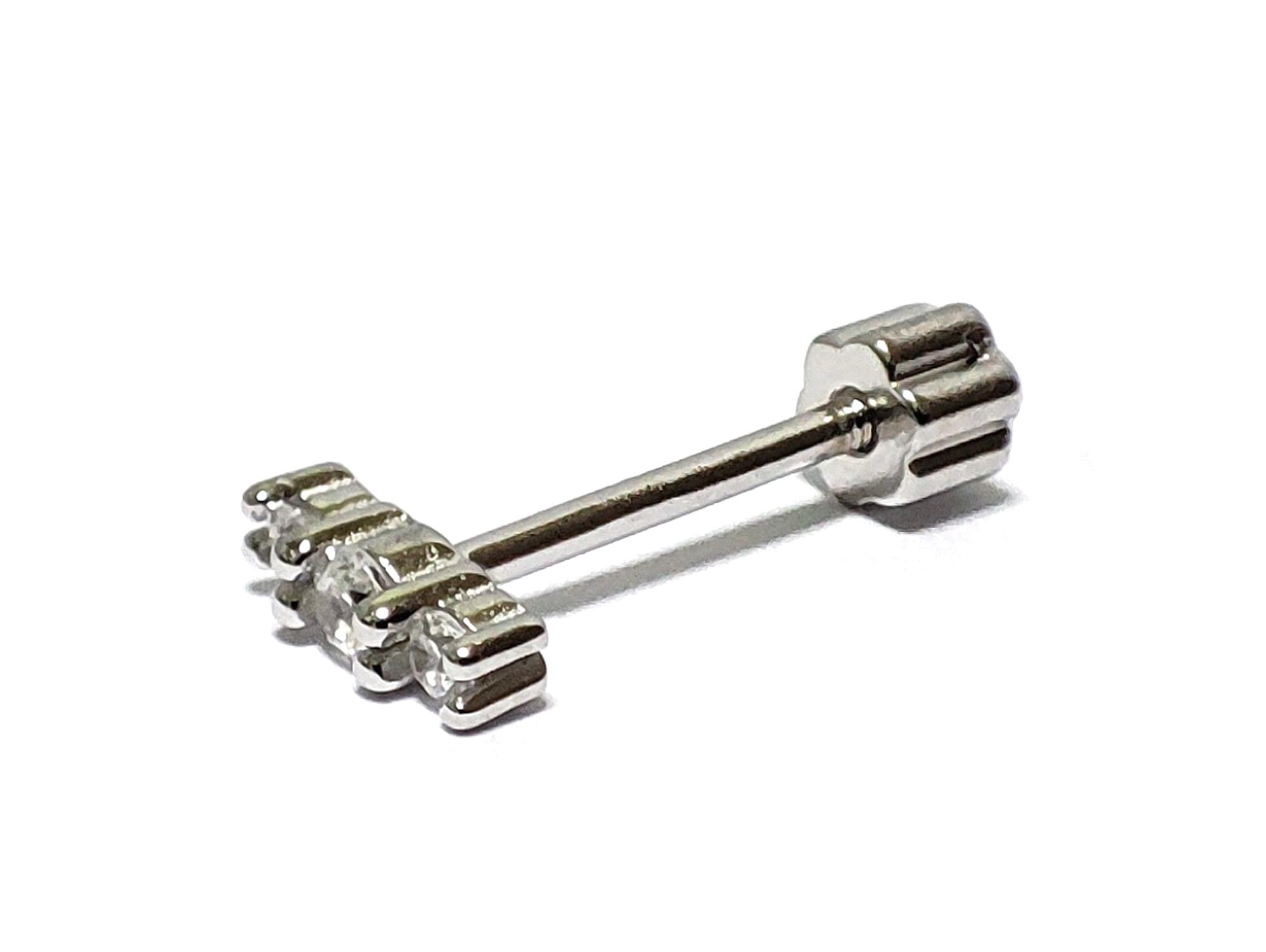
The main risk is fit. Measure the inner diameter against the part of your ear you plan to wear it on, and if you are between sizes, size up rather than down.
Studs rank third only because they need company, and among hoop earrings alternatives they are the easiest to combine. One small stud on its own disappears; three studs in descending sizes on the helix and flat create a line the eye can follow. Dangles rank fourth for stacks specifically, not because they are weak pieces, but because movement and stacking fight each other: a dangle wants to swing, and a stack wants to stay put. Use one dangle as the focal point and keep everything above and below it flat.
Cuffs and climbers rank last for a pierced stack but first for anyone who wants the look without another piercing. They are the only option here that changes the silhouette without changing your body, which makes them the safest way to test whether a stacked look suits your ear before you commit to more holes.
Watch out: ranking is not the same as suitability. A tragus piercing has very little room, so a barbell or a small flat stud will always beat a huggie there, no matter how the options rank overall.
Earrings to Stack With Studs
Studs are the easiest pieces to layer, because they are small and sit flat. A common approach is to use one slightly larger stud as the anchor and add two or three tiny ones around it.
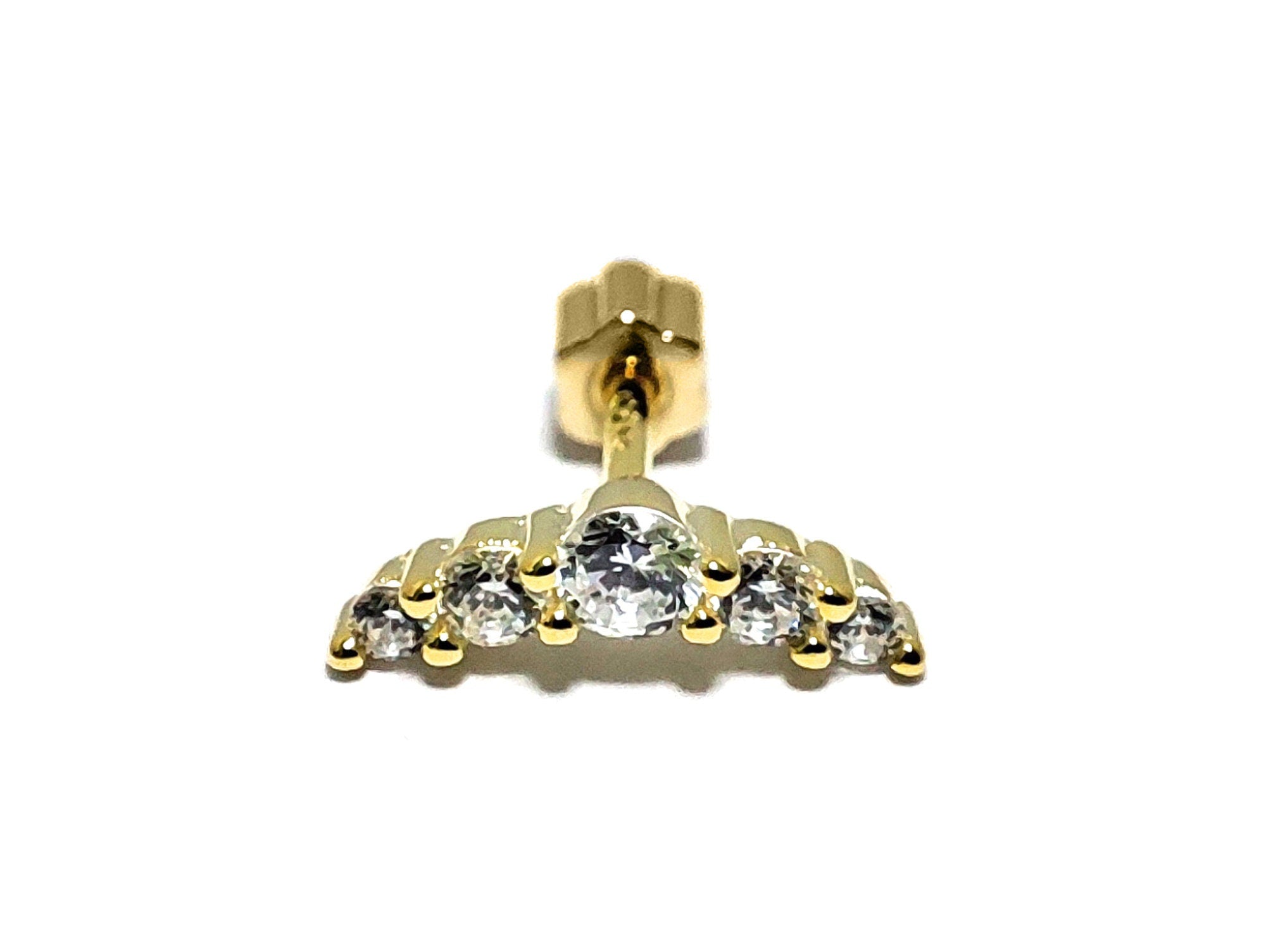
Our Silver Gold Plated Helix Stud, Cartilage Earring with CZ Crystals works well as a gold-look anchor. For a stackable helix barbell with crystal accents, consider the Silver Helix Barbell, Cartilage Earrings with 3 CZ Crystal Sets. You can also browse our Prince Albert jewelry collection for additional piercing options.
Watch out: a stud that is too large for the space will crowd its neighbours, so start small and add weight only where you need it.
Huggie Earrings for Stacks: Placement and Fit
Huggies sit close to the lobe and follow the curve of the ear, which makes them a strong base layer. Their fit depends on your ear, so check the inner diameter before you commit to a stack built around them.
Huggies work best on the lower lobe and lower cartilage, with studs or barbells above them. Keep the spacing even so the stack reads as one line rather than scattered points.
Earring Stack Ideas Built Around a Focal Piece
Every good stack has a focal piece, the one item the eye lands on first. Choose it first, then fill in around it.
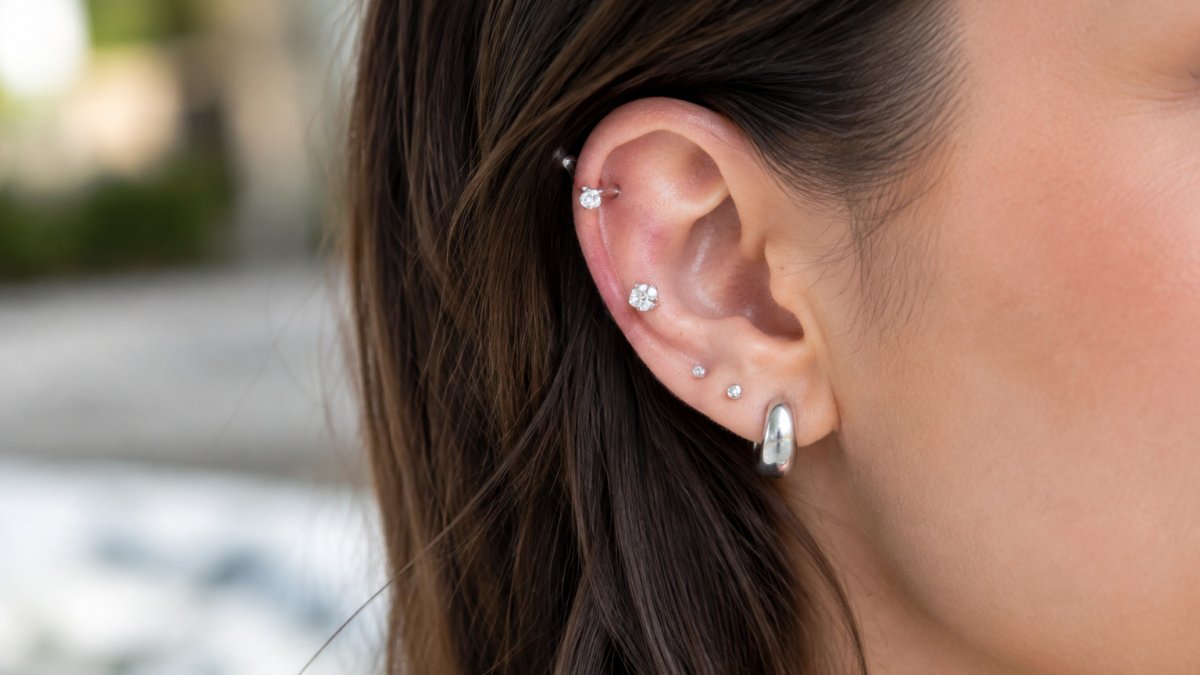
A simple structure is one dangle or barbell as the focal point, with two or three studs or small hoops in descending size. This keeps the eye moving up or down the ear rather than settling on the smallest piece.
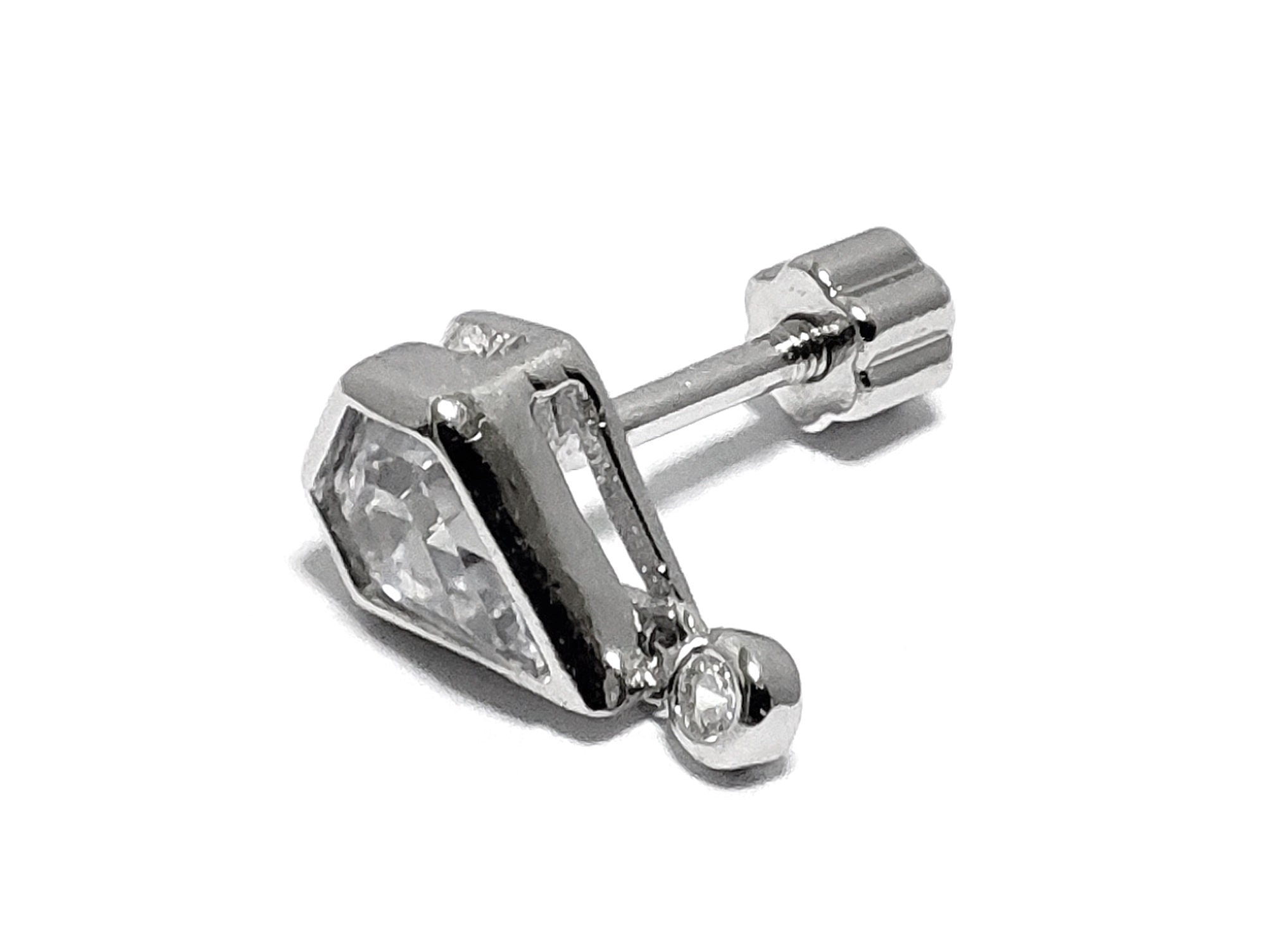
The Silver Dangly Cartilage Earring is a strong focal option for the upper helix, with clear crystals that catch light from several angles. For a softer centrepiece, the Silver Helix Flower Earring draws attention without much visual weight.
Earrings for Sensitive Ears: Materials, Comfort and Care
If your ears react to metal, material choice matters more than style. Solid gold and implant-grade titanium are often chosen by people with sensitive ears, while plated jewellery can wear over time as its surface layer thins.
Our 14K gold pieces are hallmarked by the UK Birmingham Assay Office, and our titanium is implant-grade ASTM F136. For more detail on choosing gold for sensitive skin, read our guide to best gold jewelry for sensitive ears.
Comfort in a stack is not only about metal. Weight and wear-time also matter, since lighter pieces that sit closer to the ear generally pull less on the piercing. If you sleep in your jewellery, flat-backed studs and barbells are kinder than dangles or cuffs, which press into the side of the head and can snag on pillows. A common pattern is to keep the stack simple for sleep and add the focal piece only when you are awake and dressed.
Healing piercings need a different approach. Do not stack new jewellery into a piercing that is still healing, and do not swap a healing piercing to a huggie or dangle just to complete a look. Healing cartilage piercings are generally best suited to a simple, appropriately sized barbell or flat-back stud that leaves room for swelling. Save the stacking for healed piercings, and introduce one new piece at a time so you can tell which item, if any, causes a reaction.
Care is simple: remove jewellery before swimming or exercise, clean with a soft cloth, and store pieces dry. Change jewellery only after the piercing is fully healed. If a piece does cause redness or itching, remove it and let the piercing settle before trying a different metal rather than layering more jewellery over the irritation.
Watch out: a cuff or climber worn on a healing piercing can trap moisture and bacteria against the skin, so keep non-pierced pieces for healed ears only.
Building Your First Stack From Pierced and Lovely Pieces
Start with one focal piece and one companion. Once you are happy with that pair, add a third piece in a smaller size. Avoid adding everything at once, since it becomes hard to judge the balance.
For a first stack, a practical combination is a Silver Gold Plated Cartilage Earring on the helix, a small stud on the tragus, and a stone-set piece higher up. Learn how to swap jewellery safely in our guide to safely changing your piercing jewellery before you start mixing pieces.
Frequently Asked Questions
What are the best earrings to stack?
The most reliable stack pairs one focal piece with two or three smaller supporting pieces. Silver cartilage studs, small CZ-crystal barbells and dainty helix pieces all stack well because they are light and sit flat against the ear. Mixing one larger piece, such as a dangle or a flower, with minimal studs keeps the look balanced. Choose pieces in the same metal tone for a cohesive finish, and vary only the size or shape so each piece still reads clearly on its own.
What is the 2/3 earring rule?
The 2/3 rule is a styling guideline suggesting that a stack looks most balanced when roughly two-thirds of the pieces are similar and one-third contrast. In practice, that means two or three matching studs or small barbells with one different accent, such as a dangle or a statement crystal. It is a starting point rather than a strict requirement, and you can adjust it depending on how many piercings you have and how bold you want the look to be.
Can you create an ear stack with only one piercing?
Yes. A single ear can carry a stack if you choose pieces that work at different points along the cartilage and lobe. Pair a flat-back stud with a small cartilage barbell in the upper ear, or add a huggie to the lobe. Keep the pieces lightweight and graduated in size, moving from smaller near the top to slightly larger lower down, so the arrangement looks intentional rather than crowded.
What earrings are comfortable for sensitive ears?
Comfort depends mainly on the metal and the fit. Pierced and Lovely's listed pieces are sterling silver 925 stamped, with some gold plated and some with CZ clear crystals or opal stones, so check each listing's materials before buying. Choose lightweight, flat-back or screw-back styles, avoid tight-fitting hoops that pull on healing or sensitive skin, and make sure the piercing is fully healed before changing jewellery.
