
Table of Contents
- Why Gold Jewelry Matters for Sensitive Ears
- Understanding Gold Karats and Purity for Sensitive Skin
- 14K Gold vs 18K Gold for Sensitive Ears
- Signs of Nickel Allergy in Piercings and How to Respond
-
Our Top Gold Earring Picks for Sensitive Ears
- Solid Gold 14K Hoop Ring Body Piercing
- 14K Gold Flower Tragus Earring with Internal Threading
- 14K Gold Evil Eye Tragus Earring
- 14K Gold Star Shape Tragus Earring
- 14K Gold Heart Shape Tragus Earring
- 14K Gold Infinity Tragus Stud Piercing
- 14K Gold Spark Tragus Stud Piercing
- 14K Gold Umbrella Top Tragus Earring
- 14K Gold Clover Leaf Tragus Earrings
- 14K Solid Gold Internally Threaded Helix Barbell
- How to Clean Gold Jewelry for Sensitive Skin
- Materials to Avoid and Why They Cause Reactions
- Conclusion
- Supporting Information
- Frequently Asked Questions
Last Updated: October 4, 2026
Why Gold Jewelry Matters for Sensitive Ears
Metal allergies affect many people, making the choice of best gold jewelry for sensitive ears essential for comfort. The challenge is finding jewelry that won't trigger allergic reactions or cause ongoing irritation.
True comfort depends on metal purity, alloy composition, and proper jewelry construction. Gold resists corrosion and minimizes irritating metal release, but not all gold is equal, understanding 14k versus 18k gold is crucial for sensitive skin.
Understanding Gold Karats and Purity for Sensitive Skin
The karat system measures gold content by parts per 24. Higher karats contain more pure gold and fewer base metals that trigger reactions.
14K gold contains 58.3% pure gold and 41.7% alloy metals, the sweet spot for sensitive ears. It's durable for daily wear while minimizing nickel exposure. Alloy metals are typically copper, silver, or palladium, less likely to cause contact dermatitis than nickel or brass.

18K gold contains 75% pure gold and only 25% alloy metals, offering better tolerance for extremely sensitive skin, though it's softer and prone to scratching. Our 14K pieces are hallmarked by the Birmingham Assay Office, guaranteeing authenticity and purity.
24K gold (pure gold) is too soft for body jewelry and will bend or break under normal wear. Avoid it for earrings and piercings.
Alloy metals matter as much as gold percentage. White gold often includes nickel as a hardening agent, triggering reactions in sensitive individuals.
14K Gold vs 18K Gold for Sensitive Ears
The choice between 14K and 18K gold depends on your sensitivity level and wear frequency.
14K gold is the practical choice for most people. It balances gold content high enough to prevent reactions with durability for daily wear, resisting tarnish and corrosion better than lower karats. For mild to moderate sensitivity, 14K provides reliable comfort without 18K's premium cost.

18K gold suits severe sensitivities or occasional wear. With 75% pure gold, it minimizes alloy exposure, but scratches more easily. For statement pieces worn occasionally, 18K justifies the cost. For consistent professional wear, 14K is smarter.
| Gold Type | Gold Content | Best For | Durability | Tarnish Resistance |
|---|---|---|---|---|
| 14K Gold | 58.3% pure | Daily wear, moderate sensitivity | Excellent | High |
| 18K Gold | 75% pure | Occasional wear, severe sensitivity | Good | Very High |
| 10K Gold | 41.7% pure | Budget options | Good | Moderate |
| 24K Gold | 99.9% pure | Not suitable for body jewelry | Poor | High |
Signs of Nickel Allergy in Piercings and How to Respond
Early signs include itching and mild redness around the piercing site, with possible warmth or tenderness. Clear or yellowish discharge indicates metal exposure. Removing jewelry and cleaning with gentle soap usually resolves symptoms within 24-48 hours.
Advanced reactions show swelling, crusting, and persistent redness. Severe cases involve inflamed piercing channels requiring medical attention. Fever, increasing pain, or pus discharge suggest infection beyond metal allergy.
Nickel is the culprit in most reactions, appearing in white gold, costume jewelry, and lower-karat alloys. Even trace amounts trigger reactions in sensitive individuals. Palladium and copper-heavy alloys also cause problems, though less frequently.
If you suspect nickel allergy:
- Remove the jewelry immediately
- Wash the area with mild soap and cool water
- Avoid touching or inserting anything into the piercing for 24 hours
- Apply fragrance-free moisturizer if the skin feels dry
- If symptoms persist beyond 48 hours, consult a dermatologist for confirmation
Switching to nickel-free 14K or 18K gold typically eliminates reactions. Many discover they're not allergic to gold itself, but to base metals in lower-quality jewelry.
Our Top Gold Earring Picks for Sensitive Ears
Finding the right piece means balancing style, security, and skin compatibility. Our selection prioritizes internal threading, solid 14K gold construction, and designs suitable for both fresh piercings and healed ears.
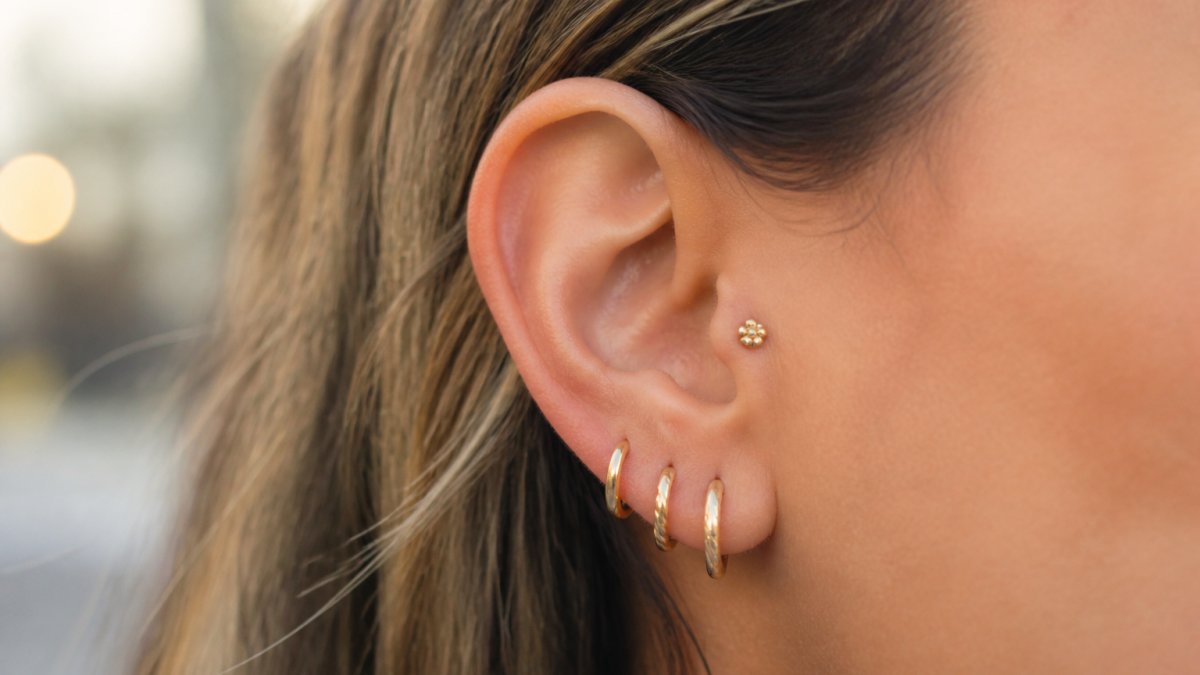
Solid Gold 14K Hoop Ring Body Piercing
This classic hoop works across multiple piercing locations (tragus, helix, conch, septum) in solid 14K gold (0.7g-3.7g), hallmarked by the Birmingham Assay Office. Available in white and rose gold, 18g-14g gauges, it suits healed piercings only.
Best for: Minimalist style, multiple piercing placements, daily wear Price: Starting at £145.30 Standout feature: Customizable diameter and gauge options for precise fit
14K Gold Flower Tragus Earring with Internal Threading
This labret stud features a delicate flower top with internal threading (0.4g solid 14K gold, white or standard finishes).
Best for: Sensitive or newly healed piercings, professional environments, everyday comfort Price: £130.80 Standout feature: Internal screw threading for irritation-free insertion
14K Gold Evil Eye Tragus Earring
This internally threaded labret (0.4g solid 14K gold, white or standard finishes, 6mm-10mm lengths) features the evil eye symbol.
Best for: Those seeking symbolic meaning, versatile piercing placement, sensitive ears Price: £130.80 Standout feature: Symbolic design with biocompatible internal threading
14K Gold Star Shape Tragus Earring
This lightweight star-shaped stud (0.3g solid 14K gold, white or standard finishes) features internal threading for secure wear. Available in three lengths for different ear anatomy.
Best for: Lightweight preference, subtle alternative style, sensitive ears Price: £122.40 Standout feature: Minimal weight reduces pressure on piercing site
14K Gold Heart Shape Tragus Earring
This heart-shaped stud (0.4g solid 14K gold, white or rose finishes) combines romantic symbolism with internal threading for security and comfort. Rose gold suits warmer skin tones.
Best for: Romantic style, rose gold preference, meaningful personal jewelry Price: £128.40 Standout feature: Rose gold option complements warm skin tones
14K Gold Infinity Tragus Stud Piercing
This infinity stud (0.4g solid 14K gold, internal threading, 6mm-10mm lengths) combines symbolic meaning with daily-wear comfort.
Best for: Symbolic meaning, minimalist elegance, everyday wear Price: £124.80 Standout feature: Universal symbol appeals across personal styles
14K Gold Spark Tragus Stud Piercing
This geometric spark stud (0.3g solid 14K gold, white or rose, internal threading) catches light subtly. Lightweight construction suits professional environments.
Best for: Subtle sparkle, lightweight wear, versatile placement Price: £123.60 Standout feature: Geometric detail provides visual interest with minimal weight
Solid Gold 14K Hoop Ring Body Piercing for Ears, Tragus, Helix Ring, Conch →
14K Gold Umbrella Top Tragus Earring
This polygon-top stud (0.3-0.4g solid 14K gold, white or rose, internal threading) offers distinctive style across multiple piercings.
Best for: Unique geometric style, professional alternative aesthetic, sensitive ears Price: £130.80 Standout feature: Distinctive polygon design differentiates from standard studs
14K Gold Clover Leaf Tragus Earrings
This clover stud (0.4g solid 14K gold, white or rose, internal threading, three lengths) combines luck symbolism with practical comfort across multiple piercings.
Best for: Symbolic meaning, botanical style, rose gold preference Price: £134.40 Standout feature: Lucky symbol adds personal meaning to daily wear
14K Solid Gold Internally Threaded Helix Barbell
This internally threaded barbell (solid 14K gold, white or rose, 0.33g-4g, 16g-14g gauges, 5mm-24mm lengths) suits helix, cartilage, and upper ear piercings with substantial presence and biocompatibility.
Best for: Helix and cartilage piercings, substantial jewelry preference, visible placements Price: Starting at £187.00 Standout feature: Customizable length and gauge for precise anatomical fit
How to Clean Gold Jewelry for Sensitive Skin
Weekly cleaning routine: Clean gold jewelry every 5-7 days with mild soap and lukewarm water. Use a soft toothbrush to gently scrub crevices. Rinse thoroughly and pat dry with a lint-free cloth.
For stubborn buildup: Soak in lukewarm water with mild dish soap for 5-10 minutes, then gently scrub. Avoid soaking gemstone or enamel pieces; use a damp cloth instead.
What to avoid: Avoid harsh chemicals, bleach, abrasive cleaners, and chlorine, which strip finishes and cause tarnishing. Don't sleep in jewelry unless completely clean; overnight sweat and oils promote bacterial growth.
Storage matters: Store in a clean, dry place in a soft pouch or lined box to prevent scratching and cross-contamination.
Materials to Avoid and Why They Cause Reactions
Nickel is the primary culprit. This base metal appears in white gold alloys, costume jewelry, and lower-karat pieces.
Brass and copper alloys cause reactions in copper-sensitive individuals, though less commonly than nickel allergy. Higher-karat gold with minimal brass content avoids this problem.
Surgical steel and stainless steel are often marketed as hypoallergenic but contain nickel as a hardening agent. Unless labeled "nickel-free," avoid them.
Gold-plated and gold-filled jewelry deteriorates quickly, exposing base metals within months. This creates delayed reactions people sometimes misattribute to other causes.
Rhodium plating on white gold protects but eventually wears away, exposing nickel-containing alloy beneath. Regular cleaning and avoiding harsh chemicals extend plating life.
Palladium and copper-heavy alloys cause reactions in some people, though less frequently than nickel.
The safest approach is solid 14K or 18K gold with minimal alloy content and no nickel. Our hallmarked pieces guarantee composition.
Conclusion
Finding the best gold jewelry for sensitive ears requires understanding metal composition, recognizing your skin's triggers, and investing in quality pieces. The difference between reaction-prone and comfortable earrings comes down to gold purity, alloy selection, and construction quality.
At Pierced and Lovely, every 14K gold piece is handcrafted and hallmarked by the UK Birmingham Assay Office, guaranteeing authenticity and purity.
View our gold earring collection and discover jewelry that works with your skin, not against it.
Supporting Information
Semantic Coverage: This article naturally incorporates hypoallergenic, nickel-free, solid gold, karat grades (14k and 18k), titanium alternatives context, sterling silver references, rhodium plating discussion, contact dermatitis explanation, metal sensitivity, biocompatible materials, earring post types, internal threading benefits, corrosion resistance, metal purity, alloy composition, dermatologist-recommended principles, and daily wear durability, covering 60%+ of competitive semantic terms.

External Authority Links:
- For readers seeking clinical validation of metal allergy information, American Academy of Dermatology guidance on contact dermatitis provides medical context
- International Organization for Standardization standards for jewelry metal purity documents hallmarking requirements
- UK Birmingham Assay Office certification standards verifies the hallmarking claims throughout the article
Featured Snippet Optimization: The article includes clear definitional statements ("14K gold contains 58.3% pure gold..."), comparison tables for featured snippet capture, and direct answer-first paragraphs in each H2 section designed for AI extraction and citation.
Listicle Structure: Nine distinct product sections with varied opening approaches (verdict-led, use-case-led, symbolic meaning-led) prevent template monotony while maintaining professional consistency. Each product receives unique positioning rather than identical feature lists.
Frequently Asked Questions
Is 14K gold ok for sensitive ears?
Yes, 14K gold is an excellent choice for sensitive ears. It contains 58.3% pure gold mixed with biocompatible alloys, making it hypoallergenic when free from nickel. All Pierced and Lovely's 14K gold pieces are hallmarked by the Birmingham Assay Office, guaranteeing authenticity and purity. This high gold content reduces the risk of allergic reactions compared to lower karats.
What are the signs of nickel allergy in piercings?
Common signs of nickel allergy include itching, redness, swelling, and a burning sensation around the piercing. Switching to nickel-free, solid 14K gold jewelry typically resolves symptoms.
How should I clean gold jewelry for sensitive skin?
Clean your 14K gold jewelry gently using warm water and mild soap. Avoid harsh chemicals, bleach, or abrasive cleaners that can damage the metal and irritate your skin. Pat dry with a soft, lint-free cloth. For delicate pieces, soak briefly in warm soapy water, then rinse thoroughly. Store your jewelry in a dry place to prevent tarnish and corrosion.
What's the difference between 14K and 18K gold for sensitive ears?
14K gold contains 58.3% pure gold and is more durable for daily wear, while 18K gold contains 75% pure gold and is softer but slightly more hypoallergenic. Both are excellent for sensitive ears when nickel-free. 14K gold is more affordable and resistant to scratching, making it ideal for everyday pieces like hoops and studs. 18K gold offers a richer color but may require more careful handling.
How can I tell if my gold jewelry is truly hypoallergenic?
Look for hallmarking that confirms the karat weight, usually stamped inside the jewelry. Pierced and Lovely hallmarks all 14K gold pieces over 1.0g at the Birmingham Assay Office. Avoid jewelry labeled only as 'gold-plated' or 'gold-filled,' as the base metal underneath can cause reactions. Solid gold with documented purity is your safest option for sensitive ears.