
Table of Contents
- Quick Comparison: 14k Gold vs Titanium for Piercings
- What Is Implant-Grade Titanium for Piercings?
- Is 14k Gold Safe for Healing Piercings?
- Signs of Metal Allergy in Piercings and How to Spot Them
- Healing Times, Material Suitability, and the Fresh vs Healed Piercing Rule
- PVD Gold-Coated Titanium vs Solid 14k Gold: What's the Difference?
- 14k Gold vs Titanium: Weight, Comfort, and Long-Term Wear
- Frequently Asked Questions
Last Updated: September 29, 2026
Quick Comparison: 14k Gold vs Titanium for Piercings
Choosing between 14k gold vs titanium for piercings comes down to one question: is the piercing still healing, or is it fully healed? Implant-grade titanium is the safer choice for fresh piercings because it is nickel-free and biocompatible, while solid 14k gold suits healed piercings where you want a warmer, more refined look. At Pierced and Lovely, we handcraft pieces that combine both: an implant-grade ASTM F-136 titanium bar with solid 14k gold balls, so you get safety where it matters and style where it shows.

Here is the short version before the detail:
| Factor | Implant-Grade Titanium | Solid 14k Gold |
|---|---|---|
| Best for | Fresh and healing piercings | Fully healed piercings |
| Nickel content | Nickel-free | Trace nickel in the alloy |
| Weight | Lighter | Noticeably heavier |
| Finish options | Polished or anodized colours | Yellow, white, or rose tones |
| Cost | Lower entry point | Higher, reflects gold content |
| Long-term look | Stays grey or keeps its anodized colour | Develops a soft patina over time |
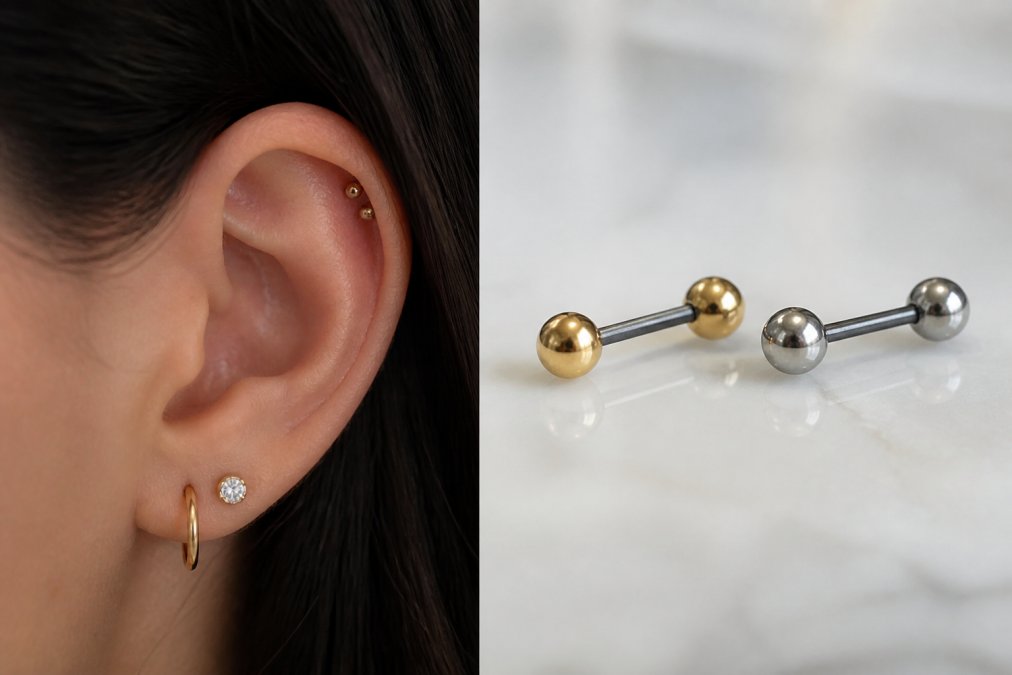
What Is Implant-Grade Titanium for Piercings?
Implant-grade titanium is a biocompatible metal refined to meet the ASTM F-136 standard, the same specification used for surgical implants. That standard limits trace elements to levels the human body tolerates well, which is why piercers reach for it first when a piercing is fresh.
The practical takeaway: "implant-grade" is a specific claim, not a marketing word. If a piece does not state ASTM F-136, treat the label as unverified.
Titanium is also light, strong, and resistant to corrosion, so it holds up to daily wear without bending. It can be anodized to a range of colours without any plating that could flake. For anyone with sensitive skin or a known nickel allergy, this is the material that removes the guesswork.
Is 14k Gold Safe for Healing Piercings?
Solid 14k gold is generally safe for healed piercings, but it is not the first choice for a fresh one. The reason is composition: 14k gold is an alloy, roughly 58% pure gold mixed with other metals to give it strength and colour. Those added metals can include a small amount of nickel.
A fully healed piercing with an established fistula handles that trace nickel far better than a wound still closing. During healing, the skin is open and the immune system is already working, so any irritant gets a stronger reaction.
This is where the fresh versus healed rule earns its keep. If your piercing is new, start with implant-grade titanium. Once it is fully healed and settled, switching to solid 14k gold is a comfortable, low-risk upgrade. Every Pierced and Lovely gold piece is hallmarked in the UK Birmingham Assay Office, so the gold content is independently verified rather than taken on trust.
Signs of Metal Allergy in Piercings and How to Spot Them
The clearest signs of a metal allergy in a piercing are persistent redness, itching, swelling, and a crusty or weeping discharge that does not improve after the first few weeks. A true allergy usually shows up as contact dermatitis: dry, flaky, itchy skin right where the metal touches.
Watch for these signals:
- Redness and swelling that returns every time you wear a specific piece
- Itching or a burning sensation around the piercing channel
- Dry, scaly, or cracked skin near the jewellery
- A rash that spreads slightly beyond the piercing site
- Symptoms that fade within days of removing the piece
That last point matters most. If the reaction clears when the jewellery comes out and returns when it goes back in, the metal is the likely cause. If you suspect a nickel sensitivity, implant-grade titanium is the sensible swap while you work out what your skin tolerates. For anything severe or spreading, see a doctor rather than guessing.
Healing Times, Material Suitability, and the Fresh vs Healed Piercing Rule
Healing time decides the material, not personal preference. Earlobe piercings typically settle in around six to eight weeks, while cartilage piercings can take several months to a year to fully heal. The longer the healing window, the more a nickel-free metal matters.
The rule is simple:
Titanium Nipple ring, Septum Nose →
- Fresh piercing: implant-grade titanium only. Nothing plated, nothing with unknown alloy content.
- Healing but settling: stay with titanium, and do not change jewellery early.
- Fully healed: solid 14k gold becomes a safe, comfortable option.
Swelling is the other variable. A fresh piercing swells, so the initial jewellery needs a little extra length to allow for it. Changing to a shorter or heavier piece too soon traps irritation and slows everything down. This is why downsizing is a step you take after healing, not during it.
PVD Gold-Coated Titanium vs Solid 14k Gold: What's the Difference?
PVD gold-coated titanium is a titanium base with a thin gold-coloured coating applied through physical vapour deposition. Solid 14k gold is gold all the way through. The two look similar in a photo and behave very differently over time.
How PVD works: In a vacuum chamber, gold vapour is deposited onto the titanium surface at a molecular level, creating a hard, wear-resistant layer. This coating is typically 0.5 to 2 microns thick, far thinner than a human hair. It bonds well, but it is still a layer. Over months or years of wear, especially in high-friction spots like the inside of a helix or a constantly moving daith, that layer can thin, scratch, or flake, revealing the grey titanium beneath. Once the coating is compromised, the piece cannot be restored to its original gold look.
Solid 14k gold has no layer to wear through. The colour is the metal itself, consistent from surface to core. It can be polished back to a shine indefinitely, and it ages gracefully, developing a soft patina that many wearers prefer to a factory finish. This patina, a natural oxidation that darkens the gold slightly, can be removed with a jewellery polishing cloth whenever you want the original brightness back.
The anodization alternative: Titanium can also be coloured without any plating at all. Through anodization, an electrical current is passed through the metal in an electrolyte bath, thickening the natural oxide layer on the surface. By varying the voltage, you can create a range of colours, from bronze and gold to blue, purple, and even black. Unlike PVD, anodized titanium has no applied coating; the colour is part of the metal's own oxide layer. It will not flake or peel, though it can fade over time with heavy wear or exposure to certain chemicals. For those who want a gold-like look without the risk of plating wear, anodized titanium is a durable, biocompatible option.
Cost and longevity: PVD titanium keeps the price down and gives you the gold look on a titanium base, which is a smart option for a healed piercing on a budget. Solid gold costs more because you are paying for real gold content, verified by a hallmark.

14k Gold vs Titanium: Weight, Comfort, and Long-Term Wear
Weight is the difference you feel rather than see. Titanium has a density of about 4.5 grams per cubic centimetre, while 14k gold is roughly 13 to 14 grams per cubic centimetre, nearly three times heavier. That means a gold piece of the same dimensions will feel noticeably more substantial against your skin.
Frequently Asked Questions
Is 14k gold or titanium better for a new piercing?
Implant-grade titanium is the safer choice for a fresh piercing. It contains no nickel, is biocompatible, and works with your body during the 6-12 month healing window. Solid 14k gold can work for some people, but it contains alloy metals that may irritate a healing piercing. Wait until your piercing is fully healed before switching to 14k gold pieces like the titanium labret studs with 14k gold balls from Pierced and Lovely.
Does 14k gold contain nickel?
Yes, 14k gold is an alloy made of 58.3% gold mixed with other metals, and nickel is sometimes part of that mix. The amount varies by manufacturer. If you have a nickel sensitivity, check with the seller before buying. Implant-grade titanium is nickel-free, making it a safer option if you have reacted to jewelry before.
How do I know if my piercing jewelry is high quality?
Look for specific markers. Implant-grade titanium should meet ASTM F-136 standard, which ensures it is safe for medical implants. Solid 14k gold should carry a hallmark, such as the UK Birmingham Assay Office stamp. Avoid vague terms like 'surgical steel' or 'hypoallergenic' without certification. At Pierced and Lovely, all 14k gold is hallmarked, and titanium is ASTM F-136 certified.
Can you get an allergic reaction to 14k gold piercings?
Yes, though it is less common than with lower-karat gold or nickel-heavy alloys. Reactions to 14k gold usually come from the alloy metals, not the gold itself. Signs include redness, itching, swelling, or a rash around the piercing. If you notice these symptoms, switch to implant-grade titanium while the irritation settles, then reintroduce gold only after the piercing is fully healed.
Why is implant-grade titanium recommended for initial piercings?
Implant-grade titanium is lightweight, nickel-free, and biocompatible, meaning your body tolerates it well during healing. It resists corrosion and does not react with bodily fluids. Professional piercers prefer it because it reduces the risk of irritation and allergic reaction. It also comes in standard gauges like 16G (1.2mm) and 14G (1.6mm), which fit most initial jewelry.