
Table of Contents
- What Makes a Nose Ring Hypoallergenic
- Implant-Grade Titanium Nose Rings: The Gold Standard for Sensitive Skin
- 14K Gold Nose Rings for Hypoallergenic Wear
- Nose Ring Gauge and Length: Finding Your Fit
- Best Nose Studs for Sensitive Skin
- Top Hypoallergenic Nose Ring Options
- Materials to Avoid for Sensitive Piercings
- Preventing Irritation and Allergic Reactions
- Frequently Asked Questions
Last Updated: October 12, 2026
The wrong material can trigger irritation within hours. At Pierced and Lovely, we help customers find hypoallergenic nose rings that work for their skin. This guide covers the materials, standards, and options that protect sensitive skin.
What Makes a Nose Ring Hypoallergenic
A hypoallergenic nose ring uses materials that minimize allergic reactions and irritation. The key isn't just avoiding nickel, it's choosing biocompatible metals your body tolerates without inflammation.

True hypoallergenic nose rings use metals with minimal impurities and no hidden nickel, and should come with documentation proving composition, not just marketing language.
Many people assume all gold is safe. It isn't. Gold-plated jewelry hides nickel in the base metal, which leaches through the coating over time.
Implant-Grade Titanium Nose Rings: The Gold Standard for Sensitive Skin
Implant-grade titanium is the most reliable choice for sensitive piercings.
Titanium is lightweight, durable, and doesn't corrode or discolor. It's naturally hypoallergenic because it forms a stable oxide layer that prevents the metal from leaching into your skin.
Body jewelry titanium comes in two grades. Implant-grade titanium (ASTM F136) is the one you want; commercially pure titanium lacks the precise alloy composition sensitive skin needs.
At Pierced and Lovely, all our titanium nose rings use implant-grade material, tested regularly with the Sheffield Assay Office to verify composition. You get documented proof of what you're wearing.
ASTM F136 Certification and Quality Standards
ASTM F136 is the international standard for implant-grade titanium used in surgical applications, covering purity, alloy composition, and processing methods.
The certification matters because it's verifiable. A manufacturer claiming "medical-grade titanium" without ASTM F136 documentation is making an unverifiable claim. ASTM F136 is a specification you can check, not a marketing term.
Quality control separates a cheap titanium nose ring from one that performs.
When evaluating a titanium nose ring, ask for proof of ASTM F136 certification. Reputable sellers provide documentation; we include quality reports in our listings. If a seller won't show proof, that's a red flag.
Why Titanium Works for Metal Allergies
Titanium works for metal allergies because it doesn't release ions into your skin the way other metals do.
Titanium's oxide layer acts as a barrier, preventing the metal underneath from contacting your skin directly.
Titanium differs from stainless or surgical steel, which contain nickel as part of their alloy; even "nickel-free" stainless steel often has trace amounts.
14K Gold Nose Rings for Hypoallergenic Wear
Solid gold is the other genuinely hypoallergenic option for nose jewelry, offering warmth and luxury for people who want their piercing to feel like fine jewelry rather than medical-grade material.
The key word is solid. 14K gold contains 58.3% pure gold mixed with alloy metals for strength and durability.
Gold works by sheer material stability rather than an oxide layer.
At Pierced and Lovely, all our 14K gold pieces are hallmarked by the UK Birmingham Assay Office, an official certification that the piece contains exactly the gold content stated.
Solid Gold vs. Plated: Why Purity Matters
Gold-plated jewelry is a false economy for sensitive skin.
Plating typically lasts 6 to 12 months with daily wear, and even less in a nose ring due to constant moisture and friction.
Gold-filled jewelry sits between plated and solid, with a thicker layer of gold bonded to a base metal.
Solid gold eliminates this risk entirely. There's no base metal and no plating to wear away; what you're wearing today is what you'll be wearing in five years.
Solid gold costs more because you're getting actual gold, but for sensitive skin it's the only choice that makes sense.
Nose Ring Gauge and Length: Finding Your Fit
Gauge and length directly affect comfort and healing. Getting these wrong creates irritation that has nothing to do with material and everything to do with fit.
Gauge refers to the thickness of the post that goes through your piercing. Standard nose piercings are 18 gauge (1.0mm) or 20 gauge (0.8mm); some people have 16 gauge (1.2mm), especially if they've stretched.
Length is the distance from the bottom of the post to the top of the nose ring. Too short creates pressure and irritation; too long sticks out or catches on things.
Common Gauge Sizes and What They Mean
20 gauge (0.8mm) is the most common size for professional initial piercings: thin enough for minimal healing trauma, stable enough to hold jewelry without excessive movement.
18 gauge (1.0mm) is thicker and more stable. Some prefer the more secure feel; others find it creates too much pressure on a fresh piercing.
16 gauge (1.2mm) and larger are typically worn by people who've stretched their piercings or were pierced with a larger needle.
Your piercing's gauge is fixed once healed; going thinner risks closing, and going thicker requires deliberate stretching. When buying a nose ring, match your existing gauge.
Post Length and Shaft Sizing for Comfort
Post length directly impacts how your nose ring sits and feels. Too short creates constant pressure against the inside of your nostril; too long lets the jewelry move and rotate, irritating the piercing.
Titanium Nose Hoop, Nose Ring - C-Type Hypoallergenic Nose Nail Piercing - 20g →
Standard post length for nostril studs is 6.5mm to 7mm, assuming typical anatomy. Thicker nasal tissue needs slightly longer posts; thinner tissue prefers shorter.
When ordering a nose ring, check the shaft length specification; don't assume all nose studs are the same. A C-type hoop, for example, typically has a 6.5mm to 7mm shaft to position the decorative element at the nostril edge.
Best Nose Studs for Sensitive Skin
Nose studs are the most popular choice for everyday wear: secure, discreet, and available in endless styles.
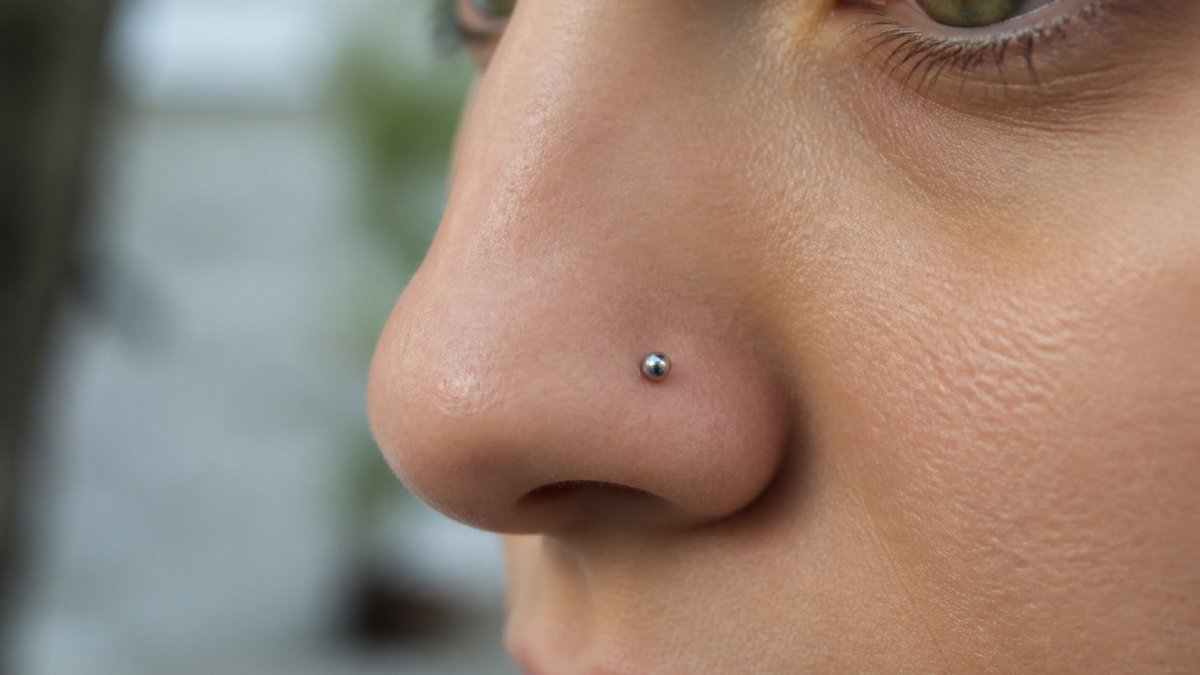
The best nose studs for sensitive skin use implant-grade titanium or solid 14K gold.
Titanium studs at Pierced and Lovely start at 9.99 in multiple gauges and colors. Our Titanium Nostril Ball Studs feature a fixed 2mm ball top in black, gold, or rose gold: no unscrewing, no shifting, just stable, comfortable wear.
For more visual interest, our Nostril Screw Studs with CZ Crystals combine implant-grade titanium with AAA+ bezel-set crystals in Aurora Borealis, Aquamarine, Clear, Jet Black, and Pink Sapphire.

Titanium Spike Studs offer a bolder aesthetic in three spike sizes (3x3, 3x4, 3x6) and gauges 18g or 16g for 10.50, making a statement while staying professionally wearable.
Top Hypoallergenic Nose Ring Options
Titanium C-Type Hoops for Everyday Versatility
C-type hoops bridge studs and traditional hoops.
Titanium Nose Hoop C-Type from Pierced and Lovely comes in four gauges (20g, 18g, 16g, 14g), sizes from 6mm to 12mm, and black, silver, gold, or rose gold finishes for 10.00.

The C-type design is forgiving for healing piercings: the open side allows easy cleaning and reduces pressure. Once healed, it becomes a daily-wear staple, and many people rotate multiple sizes and colors.
Titanium Studs with Secure Ball Tops
Studs with fixed ball tops eliminate the worry of losing the decorative element. Unlike threaded studs, fixed tops stay intact through daily wear, exercise, and sleep.
Our Titanium Nostril Ball Studs are implant-grade ASTM F136 with Vacuum Plated. The 2mm fixed ball comes in multiple colors with a 6.5mm to 7mm shaft for standard nostril anatomy, at 9.99.
Titanium Screw Studs with Crystal Detail
For jewelry that catches light and draws attention, crystal-topped studs offer visual interest without sacrificing material safety.
Our Nostril Screw Studs with CZ Crystals use AAA+ crystals in five colors and let you change just the top to rotate styles. At 9.99 in gauges 22g, 20g, and 18g, they cost the same as plain ball studs with more visual personality.
Clear Retainers for Workplace Discretion
Clear retainers keep your piercing open while maintaining a professional appearance. These flexible, transparent studs are designed to be nearly invisible.
Our Nostril Screw Piercing Retainer is hypoallergenic and comfortable for daily wear. The flexible material is gentle on healing piercings, and the transparent design suits corporate environments. At 5.99 in 20g only, it's our most affordable option.
| Option | Material | Price | Best For | Key Feature |
|---|---|---|---|---|
| Titanium Ball Studs | Implant-grade titanium | 9.99 | Everyday wear, sensitive skin | Fixed top, won't unscrew |
| Titanium C-Type Hoop | Implant-grade titanium | 10.00 | Versatile styling | Available 6mm-12mm sizes |
| CZ Crystal Studs | Implant-grade titanium | 9.99 | Visual interest with safety | AAA+ crystals, 5 colors |
| Titanium Spike Studs | Implant-grade titanium | 10.50 | Bold aesthetic | 3 spike sizes available |
| Clear Retainer | Flexible, hypoallergenic | 5.99 | Workplace discretion | Nearly invisible |
Materials to Avoid for Sensitive Piercings
Surgical steel contains nickel. Despite the medical-sounding name, it's an alloy that typically includes 8-12% nickel, and even "nickel-free" versions often contain trace amounts.
Sterling silver tarnishes and can irritate sensitive skin.
Gold-plated and gold-filled jewelry fails for sensitive skin because the base metal eventually contacts your skin.
Acrylic and plastic jewelry shouldn't be worn in fresh piercings. Even in healed piercings, plastic can break and leave fragments.
Cheap "hypoallergenic" jewelry from mass-market retailers is often mislabeled. The term has no legal definition in most countries, so sellers use it loosely to mean "probably won't cause a reaction."
Preventing Irritation and Allergic Reactions
Irritation and allergic reactions are different problems. Irritation is mechanical, caused by movement, pressure, or poor fit.
Avoid touching your piercing with unwashed hands; fingers transfer bacteria every time you adjust your jewelry.
Don't sleep on the side of your nose ring.
If you develop a reaction, remove the jewelry immediately and switch to a clear retainer or implant-grade titanium stud.
Finding the right hypoallergenic nose ring means choosing materials you can trust and a fit that works for your anatomy.
Frequently Asked Questions
What is the best hypoallergenic nose ring for sensitive skin?
Implant-grade titanium (ASTM F136) is the gold standard for sensitive skin because it contains negligible nickel and resists corrosion. Solid 14K gold is also an excellent choice, as the higher purity minimizes nickel content. Both materials have proven biocompatibility and rarely trigger allergic reactions. Avoid surgical steel, nickel-plated jewelry, and lower-karat gold, which often contain nickel despite marketing claims.
Is implant-grade titanium or 14K gold better for a sensitive nose piercing?
Both are excellent, but the choice depends on your preference and piercing stage. Implant-grade titanium is hypoallergenic, making it ideal for newly healed piercings and severe sensitivities. Solid 14K gold offers warmth and elegance for fully healed piercings and those wanting a premium aesthetic. Titanium is also available, with options like our Titanium Nose Hoop starting at 10.00. Choose based on your style preference and healing timeline.
How do I know what gauge and length nose ring I need?
Standard nostril piercings are typically 18G (1.0mm) or 20G (0.8mm), though some are 16G or 22G. Measure your piercing's thickness with a digital calliper or ask your piercer. Post length varies from 6.5mm to 7mm for most nostril studs, and hoop diameters range from 6mm to 12mm depending on your nose anatomy. Trying different sizes before purchase helps ensure comfort.
Can a hypoallergenic nose ring still cause irritation?
Yes, even hypoallergenic materials can irritate if the piercing isn't fully healed or the jewelry is too tight. Ensure your piercing is completely healed before changing jewelry, clean daily with saline solution, and avoid touching it unnecessarily. If irritation persists despite using verified hypoallergenic materials, consult your piercer to rule out infection or sizing issues.
What materials should I avoid for a sensitive nose piercing?
Avoid surgical steel, stainless steel, nickel-plated jewelry, and gold-plated pieces, as these often contain nickel or degrade to expose base metals. Sterling silver and lower-karat gold (below 14K) are also problematic for sensitive skin. Acrylic and plastic may seem safe. Stick to implant-grade titanium (ASTM F136), solid 14K or 18K gold, or platinum. Always verify material certifications rather than relying on marketing labels.