
Table of Contents
- Why Identifying Implant-Grade Titanium Matters
- What Implant-Grade Titanium Actually Means
- ASTM F136 Titanium vs Regular Titanium: Key Differences
- How to Tell If Jewelry Is Implant Grade: The Verification Checklist
- Understanding Titanium Jewelry Material Certification
- Red Flags: What to Avoid When Buying Online
- Frequently Asked Questions
Last Updated: October 5, 2026
Why Identifying Implant-Grade Titanium Matters
When you're buying body jewelry, the material label matters more than you think, and learning to identify implant grade titanium is essential. Not all titanium is created equal, and a piece labeled simply "titanium" could be anything from safe, biocompatible metal to an alloy that triggers allergies and irritation.

At Pierced and Lovely, we understand the frustration of jewelry that doesn't live up to its claims. Learning to identify implant-grade titanium protects your piercings and your health.
Implant-grade titanium meets strict international standards designed for medical use. It's not just "nice" titanium. It's titanium refined to eliminate impurities and alloys that cause inflammation, rejection, and infection. When you know what to look for, you can buy with confidence.
What Implant-Grade Titanium Actually Means
Implant-grade titanium is titanium that meets ASTM F136 or ISO 5832-3 standards, making it safe for direct contact with healing or healed tissue. These standards define exact composition limits, purity levels, and manufacturing processes.
Regular titanium, by contrast, may contain nickel, iron, or other elements that leach into tissue and cause reactions. It's cheaper to produce and perfectly fine for watches or eyeglass frames. But for jewelry in fresh piercings or sensitive skin, it's a risk you don't need to take.
The difference comes down to this: implant-grade titanium is refined to remove impurities and tested to prove it won't corrode or release harmful elements. Regular titanium skips those steps.
Here's what makes implant-grade titanium unique:
- Nickel content must be below 0.03% (regular titanium can contain much more)
- Oxygen and nitrogen levels are strictly controlled
- The material is tested for biocompatibility with human tissue
- Manufacturing and heat treatment processes are documented and verified
- Every batch comes with traceability records
When you buy from Pierced and Lovely, every implant-grade titanium piece carries documentation proving it meets these standards.
ASTM F136 Titanium vs Regular Titanium: Key Differences
The gap between ASTM F136 titanium and regular titanium is significant. Understanding the differences helps you spot misleading marketing.
ASTM F136 is the American standard for implant-grade titanium alloy (Ti-6Al-4V ELI). ASTM F67 covers commercially pure titanium grades. Both are acceptable for body jewelry, but they have different properties and composition rules.
Regular titanium has no standard. It's simply "titanium" with no guarantee of purity or safety.
| Specification | ASTM F136 (Ti-6Al-4V ELI) | ASTM F67 (Pure Titanium) | Regular Titanium |
|---|---|---|---|
| Nickel Content | <0.03% | <0.03% | Often 0.5%+ |
| Oxygen Level | Strictly controlled | Strictly controlled | Uncontrolled |
| Biocompatibility Testing | Required | Required | Not required |
| Mill Certificate | Standard | Standard | Rarely provided |
| Cost | Higher | Higher | Lower |
The key takeaway: if a seller won't provide material documentation, the jewelry probably isn't implant-grade. Real implant-grade titanium comes with proof.
How to Tell If Jewelry Is Implant Grade: The Verification Checklist
The only reliable way to identify implant grade titanium is through documentation. Visual inspection, weight tests, and magnet tests are not accurate. You need paperwork.

Follow these steps to verify a piece is actually implant-grade before you buy or wear it.
Step 1: Request Material Documentation
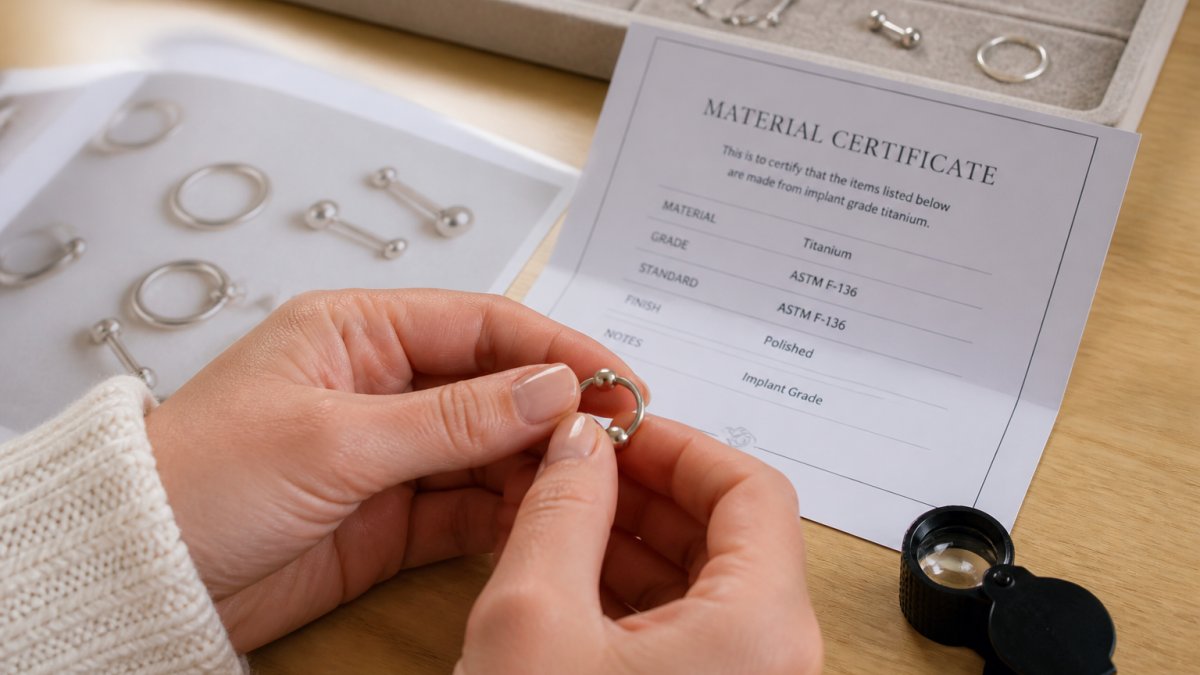
Before purchasing, ask the seller for a material certificate or mill certificate. This is the first red flag test.
A legitimate seller will provide one of these documents:
- Certificate of Compliance, states the material meets ASTM F136 or ASTM F67
- Mill Certificate, issued by the manufacturer, includes lot number and test results
- Material Test Report, third-party lab analysis confirming composition
- Product Specification Sheet, lists material grade and certifications
If the seller says "we don't have that" or "it's just titanium," move on. Implant-grade titanium always comes with documentation because manufacturers and suppliers track it for liability and quality control.
Ask specifically: "Can you provide a mill certificate or material test report showing this meets ASTM F136?"
Step 2: Verify ASTM F136 Certification
Look at the documentation for specific language. The certificate should state one of these:
- "ASTM F136" or "ASTM F67"
- "ISO 5832-3" (the international equivalent)
- "Grade 1," "Grade 2," "Grade 3," or "Grade 4" (for commercially pure titanium)
- "Ti-6Al-4V ELI" (the alloy name for ASTM F136)
- "Grade 23" (another implant-grade designation)
If the document just says "titanium" with no grade or standard, it's not implant-grade.
Certificates from reputable suppliers include a statement like: "This material meets or exceeds ASTM F136 specifications" or "ISO 5832-3 compliant."
Step 3: Check for Lot Numbers and Mill Certificates
A mill certificate includes a lot number or heat number. This proves the material was tracked from production through to your jewelry.
The lot number lets you verify:
- When the material was produced
- Which facility made it
- Test results specific to that batch
- Traceability back to the raw material source
If you see a lot number on the certificate, you can cross-reference it with the manufacturer's records.
Step 4: Assess Surface Finish and Manufacturing Details
Surface finish matters because rough or porous surfaces trap bacteria and slow healing. Implant-grade titanium jewelry should have:
- A smooth, polished finish (not rough or dull)
- No visible pitting or corrosion
- Clean threading on threaded pieces
- Proper anodizing or coating (if applicable)
The manufacturing details on the certificate should note the surface treatment. For example: "electropolished," "passivated," or "anodized." These processes remove surface contaminants and improve biocompatibility.
If you're buying online, ask for close-up photos of the piece. A legitimate seller will provide them. Look for a consistent, smooth surface without scratches, discoloration, or rough spots.
Dermal Surface Piercing, Nape Piercing - Titanium 16g 14g Implant Grade 90 →
Step 5: Understand What Home Tests Cannot Prove
A common mistake is trying to identify implant-grade titanium with a magnet, a scratch test, or a visual inspection. None of these can establish an alloy grade.
- Magnet tests are unreliable. Titanium is paramagnetic, meaning it is weakly attracted to magnets in some conditions and not in others. A magnet tells you almost nothing about whether a piece is ASTM F136, ASTM F67, or a cheap alloy.
- Visual appearance is not proof. Anodized titanium can look identical to anodized niobium, stainless steel, or coated base metal. Color comes from surface oxide thickness, not from the underlying alloy.
- Weight and feel are not diagnostic. Density varies between titanium alloys and between titanium and its common substitutes, but the difference is too small to judge by hand.
- Generic handheld "titanium testers" sold online typically measure thermal or electrical properties and cannot distinguish implant-grade from industrial-grade titanium.
- Scratch and acid tests can damage the piece and still fail to identify the specific grade.
Step 6: Match the Standard to the Use Case
Implant-grade titanium is not one single specification. The right standard depends on where the metal will be used.
- Body jewelry (fresh and healed piercings): ASTM F136 (Ti-6Al-4V ELI) or ASTM F67 (commercially pure titanium, usually Grade 1 or Grade 2) are the common choices. ASTM F136 is favored for threaded and load-bearing pieces because of its higher strength.
- Surgical implants (bone plates, screws, joint components): ASTM F136 and ASTM F67 are both used, but the required mechanical properties, surface finish, and sterilization requirements are stricter than for jewelry.
- Dental implants and abutments: Often use ASTM F67 Grades 1-4 or ASTM F136, depending on the component. Dental devices also fall under additional regulatory pathways that jewelry does not.
A piece that is acceptable for a healed earlobe piercing may not meet the requirements for a surgical implant, and vice versa. When a seller claims "implant-grade" without naming the standard and the intended use, the claim is incomplete.
Understanding Titanium Jewelry Material Certification
Certification is your proof of identity. When you see a certificate, here's what to look for.
A proper material certification includes:
- The material grade (ASTM F136, ASTM F67, Grade 23, etc.)
- Composition breakdown (percentage of titanium, aluminum, vanadium, other elements)
- Test results (tensile strength, hardness, corrosion resistance)
- Lot or heat number
- Date of manufacture
- Manufacturer name and location
- Statement of compliance with relevant standards
The certificate should come from the jewelry maker or their material supplier. If it comes from a third-party lab, that's even better, it means the material was independently tested.
Many online sellers will show you a generic "certificate" that just lists material names. That's not enough. A real certificate has numbers, test data, and traceability information.
How to Read a Material Test Report Field by Field
Most buyers never learn to read the actual document. Here is what each field means and what a complete report should show.
| Field | What it should say | Why it matters |
|---|---|---|
| Standard | ASTM F136, ASTM F67, or ISO 5832-3 | Names the specification the material was tested against |
| Alloy designation | Ti-6Al-4V ELI (Grade 23) or commercially pure Grade 1-4 | Tells you which titanium you actually have |
| Heat or lot number | A unique alphanumeric code | Lets you trace the batch back to the mill |
| Chemical composition | Element-by-element percentages (Ti, Al, V, Fe, O, N, C, H) | Confirms the alloy is within the standard's limits |
| Mechanical properties | Tensile strength, yield strength, elongation | Confirms the material was processed correctly |
| Manufacturer and location | Mill name and country | Establishes the source of the raw material |
| Date of manufacture | Production or test date | Helps you judge whether the document is current |
| Compliance statement | "Meets or exceeds ASTM F136" | The formal claim of conformity |
If any of these fields is missing, the report is incomplete. A document that lists only "titanium" and a grade name, with no composition data, no lot number, and no manufacturer, is not a material test report, it is a marketing sheet.
How to Spot Incomplete or Misleading Documentation
A common pattern is a certificate that looks official but omits the fields that would let you verify it. Watch for these signs:
- No lot or heat number. Without it, the document cannot be tied to the specific piece you are buying.
- No chemical composition. A grade name alone does not prove the alloy meets the standard.
- No manufacturer name or location. Traceability requires knowing who produced the material.
- No test date. An undated certificate could refer to a batch from years ago, or to nothing at all.
- Generic wording. Phrases like "premium titanium" or "surgical-grade titanium" are not standards and should not appear on a real report.
- A certificate for a different product. Some sellers reuse one certificate across an entire catalog. Ask whether the document is specific to the item you are buying.
- A certificate with no standard named. If ASTM F136, ASTM F67, or ISO 5832-3 is not stated, the document does not prove implant-grade status.
Questions to Ask When Buying Online
When you cannot inspect the piece in person, the documentation and the seller's answers are your only evidence. Ask these questions directly:
- Which standard does this piece meet, ASTM F136, ASTM F67, or ISO 5832-3?
- Can you send the mill certificate or material test report for this specific item?
- Does the report include a heat or lot number I can cross-reference?
- Who is the manufacturer of the raw titanium, and where is it located?
- Is the certificate specific to this piece, or is it a general catalog document?
- What is the surface finish, and is it noted on the certificate (electropolished, passivated, anodized)?
A seller who answers these clearly and provides the document is demonstrating that the material claim is real. A seller who deflects, sends a generic PDF, or says the certificate is "internal" is telling you something important.
What Product Listings and Packaging Can and Cannot Prove
Product listings, packaging, and marketing images can suggest quality, but they cannot prove alloy grade.
- Listings can prove: the seller's stated claim, the item's dimensions, the finish, and the threading style.
- Listings cannot prove: the actual alloy composition, the standard the material meets, or the batch it came from.
- Packaging can prove: the brand and the seller's stated material claim.
- Packaging cannot prove: that the metal inside matches the claim, or that the material was tested.
This is why documentation matters more than presentation. A polished listing with no certificate is weaker evidence than a plain listing that includes a complete material test report.
When buying from Pierced and Lovely, every implant-grade titanium piece includes documentation showing it meets ASTM F136 standards. We keep records of lot numbers and manufacturer details so you can verify the material's origin and composition.
Red Flags: What to Avoid When Buying Online
Certain language and practices signal that jewelry is not actually implant-grade.
Avoid these red flags:
- "Titanium-plated" or "titanium-coated", the base metal underneath is not titanium
- "Surgical steel", not the same as implant-grade titanium, and often contains nickel
- "Hypoallergenic titanium", no such thing; either it's implant-grade or it's not
- "Grade 5 titanium", this is industrial titanium, not medical-grade
- Seller cannot provide material documentation, this is the biggest warning sign
- Price significantly lower than comparable pieces
- Vague descriptions like "premium titanium" or "quality titanium" without specific grades
- No information about manufacturing or material source
Legitimate sellers are transparent. They list the exact material grade, provide certificates, and answer questions about sourcing. If a seller is evasive or dismissive about documentation, the jewelry probably isn't what they claim.
When shopping for body jewelry online, take time to contact the seller before buying. Ask for material documentation. A good seller will respond quickly and provide proof. A seller who ignores you or gives vague answers is not worth the risk to your health.
Identifying implant-grade titanium protects you from reactions, infections, and the frustration of buying jewelry you can't wear. The process is simple: ask for documentation, verify the standard, and check the details. Legitimate sellers have nothing to hide.
At Pierced and Lovely, every piece of implant-grade titanium jewelry we create comes with full material documentation and ASTM F136 certification. We also offer bespoke titanium pieces tailored to your exact anatomy, so you get a perfect fit without compromises. View products and explore our handcrafted titanium collection, each piece is made with precision and backed by verified material standards.
Frequently Asked Questions
What is ASTM F136 titanium and why does it matter for body jewelry?
ASTM F136 is the international standard for implant-grade titanium alloy used in surgical and dental applications. It specifies exact material composition, purity levels, and manufacturing processes to ensure biocompatibility and safety. For body jewelry, ASTM F136 certification guarantees the titanium meets strict standards for nickel content (maximum 0.03%), corrosion resistance, and tissue compatibility. This standard is the gold standard for piercing jewelry because it minimizes allergic reactions and ensures long-term wearability in sensitive piercings.
How can I tell if titanium jewelry is implant grade by looking at it?
Visual inspection alone cannot definitively prove implant-grade status. Color, weight, and appearance are unreliable indicators because regular titanium and implant-grade titanium look identical to the naked eye. The only reliable way to verify implant-grade material is to request a material certificate of compliance, mill certificate, or test report from the seller. Legitimate sellers like Pierced and Lovely provide documentation showing ASTM F136 certification, lot numbers, and material composition. Always ask for written proof rather than relying on labels or seller claims.
What's the difference between implant-grade titanium and regular titanium?
Implant-grade titanium (ASTM F136 or F67) is refined to extremely high purity standards with controlled alloy composition and minimal impurities. Regular titanium contains higher levels of iron, oxygen, and other elements that can trigger allergic reactions or corrode in the body. Implant-grade titanium is manufactured under strict quality controls with full traceability, while regular titanium lacks these safeguards. For body jewelry, implant-grade is essential because it's biocompatible and safe for long-term wear in fresh or sensitive piercings, whereas regular titanium can cause irritation, discoloration, and tissue reactions.
What documentation should I request to verify implant-grade titanium?
Request a certificate of compliance, mill certificate, or material test report that explicitly states ASTM F136 or ASTM F67 certification. The document should include the alloy grade (such as Grade 5 Ti-6Al-4V ELI), lot number or heat number for traceability, nickel content analysis (must be 0.03% or lower), and mechanical properties like tensile strength. Reputable sellers provide these documents upon request. If a seller cannot or will not provide written certification, the titanium is likely not implant-grade, regardless of what their listing claims.