
Table of Contents
- What You'll Need to Measure Piercing Size
- Piercing Gauge Size Chart: Decoding the Numbers
- How to Measure Piercing Diameter
- Measuring Piercing Length vs Diameter: What's the Difference?
- Standard Piercing Sizes by Location
- Using Printable Sizing Tools and Visual Identification
- Healing Stage and Material Considerations for Sizing
- Common Mistakes to Avoid When Measuring Piercing Size
- Frequently Asked Questions
Last Updated: September 25, 2026
What You'll Need to Measure Piercing Size
Getting the right fit starts with knowing your numbers before you buy. Measuring piercing size is the practice of identifying the gauge, diameter, and wearable length of your jewelry so a new piece seats correctly, feels comfortable, and stays put.
Here's what to gather before you start:
- Digital calipers for the most precise gauge and diameter readings
- A millimeter ruler or a printed gauge card as a backup
- A conversion chart to translate gauge numbers into millimeters
- Your current jewelry, if you have a piece that already fits well
- Good lighting and a steady surface, because you're measuring fractions of a millimeter
Association of Professional Piercers jewelry standards
Piercing Gauge Size Chart: Decoding the Numbers
A piercing gauge is the thickness of the jewelry measured on the American Wire Gauge scale, where a higher number means a thinner piece. That inverted logic trips up almost everyone the first time. An 18g post is thinner than a 14g post, even though 18 is the larger number.
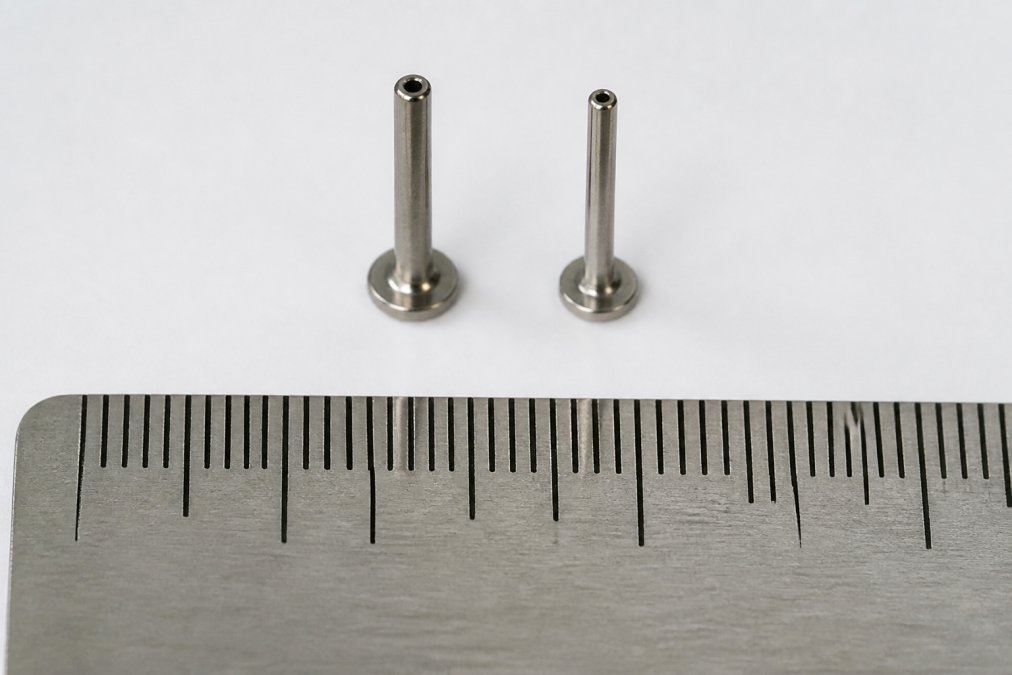
Understanding Gauge Sizes and Conversions
The chart below converts the sizes you'll see most often into millimeters, which is the unit calipers and rulers actually show you.
| Gauge | Millimeter thickness | Common use |
|---|---|---|
| 20g | 0.8 mm | Nostril screws, delicate studs |
| 18g | 1.0 mm | Standard lobe, cartilage |
| 16g | 1.2 mm | Helix, tragus, eyebrow |
| 14g | 1.6 mm | Navel, industrial, septum |
| 12g | 2.0 mm | Stretched lobe, daith |
| 10g | 2.4 mm | Larger stretched lobes, some cartilage |
| 8g | 3.2 mm | Advanced stretching, some septum |
Visual Identification: Eyeballing the Difference Between 16g and 18g
When you don't have calipers, a side-by-side visual comparison can get you close. The difference between 16g (1.2 mm) and 18g (1.0 mm) is just 0.2 mm, about the thickness of two sheets of printer paper. Under bright light, hold a known 18g piece next to an unknown piece. If the unknown piece looks noticeably thicker, it's likely 16g. If it looks identical, it's probably also 18g.
Printable Sizing Tools: A Caliper-Free Alternative
A printable sizing tool is a PDF or paper sheet with gauge and diameter markings at true scale. Print it at 100%, never "fit to page", or every measurement shifts. Most print shops and home printers default to scaling, so check your print settings carefully. Once printed, you can:
- Lay a straight barbell or post directly on the gauge lines to read thickness.
- Place a hoop over the printed diameter circles to find internal diameter.
- Use the millimeter ruler edge to measure wearable length.
Association of Professional Piercers jewelry standards
Wikipedia's American Wire Gauge reference
How to Measure Piercing Diameter
Piercing diameter is the measurement across the inside of a hoop or ring, taken from the inner edges where the jewelry meets your skin. This is the number that determines whether a ring hugs your nostril or dangles past it. Measure with calipers by opening the jaws to the inner walls of the ring and reading the millimeter scale directly.
Using Calipers vs Rulers for Accurate Measurement
Digital calipers give you the precision this task demands, usually to within 0.01 mm. A ruler works in a pinch, but you're reading to the nearest millimeter at best, and parallax error creeps in fast.
Measuring Piercing Length vs Diameter: What's the Difference?
Measuring piercing length versus diameter comes down to which direction you're measuring. Diameter is the width across a ring's interior. Length, sometimes called wearable length, is the straight distance the jewelry travels through the piercing itself. A curved barbell has both, while a simple hoop really only has a diameter.
Measuring Barbell Length and Wearable Length
Wearable length is the distance between the two balls on a barbell, excluding the threaded ends. That's the portion sitting inside your piercing, and it's what you need to match to your anatomy. If a barbell is too short, the balls press into the skin and cause irritation. Too long, and it snags on clothing or migrates.
Standard Piercing Sizes by Location
Standard piercing sizes vary by location because different anatomy needs different thicknesses and lengths. The table below covers the common starting points, though your piercer's original choice is always the best baseline.
| Piercing | Typical gauge | Typical length or diameter |
|---|---|---|
| Earlobe | 18g to 16g | 6-8 mm post |
| Nostril | 20g to 18g | 6-8 mm, or 8 mm hoop |
| Helix | 16g | 6-8 mm |
| Septum | 16g to 14g | 8-10 mm horseshoe |
| Navel | 14g | 10-12 mm curved barbell |
| Eyebrow | 16g | 8-10 mm |
Using Printable Sizing Tools and Visual Identification
A printable sizing tool is a sheet with gauge and diameter markings at true scale, letting you lay your jewelry directly on the paper to read its size. Print it at 100% scale, never "fit to page," or every measurement shifts. This is the fastest way to size a piece when you don't have calipers on hand.
Healing Stage and Material Considerations for Sizing
Healing stage changes the size you should order. A fresh piercing swells for the first few weeks, so a longer bar or larger hoop prevents the jewelry from embedding in the tissue. Once healing settles, most people downsize to a shorter wearable length for a cleaner look.
How Swelling Affects Sizing
Swelling is not uniform. It peaks in the first 48 to 72 hours, then gradually subsides over weeks or months depending on the piercing location. A nostril piercing might swell enough to need a bar 1-2 mm longer than your final size. A navel piercing, which sits in softer tissue, can swell even more. If you order your "goal size" immediately, the jewelry may press into the skin, causing irritation, migration, or embedding.
Material-Specific Sizing: How Thickness and Flexibility Affect Fit
Material choice isn't just about safety, it changes how a given size feels. Implant-grade titanium and 14k gold are rigid, so a 16g titanium labret feels exactly like a 16g gold one in terms of thickness. But silicone, PTFE, and other flexible materials behave differently. A 14g silicone tunnel can stretch to accommodate a 12g piercing because the material compresses.
NHS guidance on piercing aftercare and complications
Common Mistakes to Avoid When Measuring Piercing Size
The biggest mistake is measuring a piece while it's still in your piercing. Swelling, crusting, and angle all distort the reading. Remove the jewelry, clean it, and measure it flat.
Other pitfalls worth knowing:
- Confusing gauge with length. A 16g post tells you thickness, not how deep it sits.
- Measuring the outer edge of a hoop. Always measure the internal diameter.
- Forgetting to account for swelling. Size up for fresh piercings, down for healed ones.
- Trusting a stretched or bent piece. Warped jewelry gives a false reading, so use a fresh reference when you can.
Frequently Asked Questions
How do I know if my piercing is 16g or 18g?
The difference between 16g and 18g is small but measurable. A 16g piercing measures 1.2mm in thickness, while 18g is 1.0mm. Compare your jewelry against a piercing gauge size chart or use digital calipers for the most accurate reading. If you don't have calipers, a printable sizing tool can help. Most standard ear piercings are 18g or 16g, while cartilage piercings often use 16g. When in doubt, ask a professional piercer to confirm your size before ordering new jewelry.
Can I use a ruler to measure my piercing jewelry?
A standard ruler works for measuring diameter and length in millimeters, but it is not precise enough for gauge thickness. For gauge, you need calipers or a gauge size chart. When using a ruler, place the jewelry flat and measure the inner edge to inner edge for diameter. For length, measure the straight bar from end to end. Keep in mind that ruler measurements can be off by 0.5mm or more, so always double-check against a conversion table before buying.
What is the difference between gauge and diameter in piercings?
Gauge refers to the thickness of the jewelry wire, while diameter refers to the width of the jewelry itself. For example, a 16g nose ring has a 1.2mm wire thickness (gauge) and might have an 8mm inner diameter. Both measurements matter for fit. Gauge determines how the jewelry sits in the piercing channel, and diameter determines how it wraps around or sits against your anatomy. Always check both measurements when shopping for body jewelry.
Is a 20g piercing smaller than an 18g?
Yes, 20g is smaller than 18g. In the gauge system, higher numbers mean thinner jewelry. A 20g piercing measures 0.8mm in thickness, while 18g measures 1.0mm. This is a common point of confusion because the numbers go up as the size goes down. If you are sizing up from a 20g to an 18g, you are increasing the thickness by 0.2mm. Always size up gradually and give your piercing time to adjust, especially for cartilage piercings.
Getting the fit right is the difference between jewelry you forget you're wearing and jewelry you're constantly adjusting. At Pierced and Lovely, we handcraft 14k gold and implant-grade titanium pieces to precise measurements, offer bespoke orders for unusual placements, and back every piece with the kind of material quality that sensitive skin can trust. If you're ready to upgrade from mass-produced jewelry, view our collection and find a piece built to your exact size.