
Table of Contents
- Why Implant-Grade Titanium Piercing Jewelry Matters for Healing
- Best Metal for New Piercings: Titanium vs. Other Materials
- Understanding ASTM F136 and Material Standards
- Piercing Jewelry Sizing Guide: Getting the Fit Right
- Titanium Labret Studs and Flat-Back Earrings for Cartilage Healing
- Healing Piercings: What Works and What Doesn't
- Aftercare and When to Seek Professional Help
- Conclusion
- Frequently Asked Questions
Last Updated: October 21, 2026
Why Implant-Grade Titanium Piercing Jewelry Matters for Healing
When you get a new piercing, your jewelry determines whether healing is smooth or complicated. The best titanium jewelry for healing starts with understanding what makes titanium different. Implant-grade titanium, specifically ASTM F136 certified titanium, is biocompatible, so your body tolerates it without triggering the inflammatory response that leads to irritation, infection, or rejection.
At Pierced and Lovely, we offer implant-grade titanium for those seeking high-quality body jewelry. Titanium doesn't leach nickel or other allergens, and it's lightweight, durable, and strong enough to withstand daily wear. This matters because a compromised piercing channel takes far longer to heal, even after you switch to better jewelry.
The real value of implant-grade titanium isn't that it "promotes healing" magically. Jewelry doesn't heal piercings; your body does. Titanium removes a major obstacle: it stops irritating your piercing so your immune system can focus on closing the channel and building stable tissue.
Best Metal for New Piercings: Titanium vs. Other Materials
Your piercing is an open wound for the first few weeks to several months, depending on location and depth. During this window, the metal touching your piercing channel matters enormously. Here's how the main options compare.
Stainless Steel (often labeled "surgical steel"): Despite the name, most body jewelry stainless steel is not surgical-grade. It contains nickel, sometimes 8-12% by composition, a common allergen. It can corrode when exposed to body fluids and sweat, releasing nickel particles directly into your fresh piercing.
Gold (14K and higher): Solid gold is biocompatible and excellent for healed piercings. However, 14K gold contains alloy metals (copper, silver, zinc) that can trigger reactions in sensitive individuals, and gold is soft. A thin gold post in a fresh piercing can bend, migrate, or cause pressure damage.
Titanium (ASTM F136): This is the clear winner for new piercings. Implant-grade titanium contains less than 0.3% nickel and is virtually hypoallergenic. It's strong enough to hold its shape under a healing piercing's pressure, yet light enough not to stress the channel. It doesn't corrode or leach metals, which is why it's used in orthopedic implants and dental work.
The choice is straightforward: for any new piercing, implant-grade titanium is the standard you should demand. Everything else introduces risk.
Understanding ASTM F136 and Material Standards
ASTM F136 is a material specification developed by the American Society for Testing and Materials that defines exactly what "implant-grade titanium" means. Without this designation, jewelry isn't truly implant-grade, regardless of seller claims.
ASTM F136 titanium must meet these requirements:
- Titanium content: minimum 99.75%
- Nickel content: less than 0.3% (crucial for allergy sufferers)
- Aluminum and vanadium: controlled at low levels
- Iron, oxygen, and other impurities: strictly limited
These limits exist because orthopedic surgeons and dentists learned decades ago that even small amounts of reactive elements cause inflammation and rejection. The standard transfers directly to body jewelry because your piercing channel is essentially a surgical wound.
When you buy from Pierced and Lovely, every titanium piece is certified to ASTM F136. You'll see this listed on the product page. If you're shopping elsewhere and don't see this certification, ask the seller directly. If they can't provide it, the jewelry is not implant-grade, even if it's labeled "titanium body jewelry."
The Sheffield Assay Office in England certifies the titanium used in Pierced and Lovely's jewelry against British Standards, which align with ASTM F136.
Piercing Jewelry Sizing Guide: Getting the Fit Right
Getting the size wrong is one of the most common mistakes when changing jewelry. Too long puts pressure on your piercing channel and irritates tissue; too short can embed into skin or cause uneven closure.
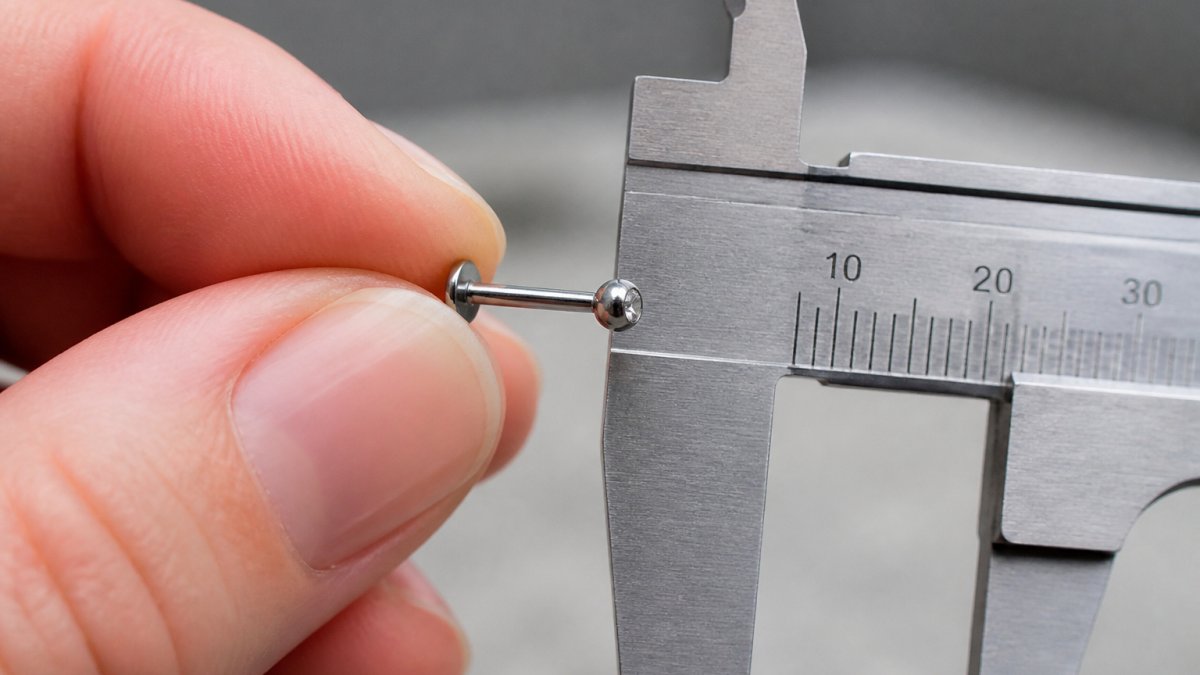
Gauge (thickness): This is measured in millimeters or gauge numbers. A 16g (1.2mm) labret is thinner than a 14g (1.6mm). Your piercer determined your gauge when they performed the initial piercing.
Length (for barbells and labrets): Measured in millimeters from one end to the other. Fresh piercings need extra length for swelling; most piercers use 8-10mm initially, then you downsize to 6-8mm once swelling subsides (usually 2-4 weeks).
Inner diameter (for rings): For horseshoe rings, clickers, and other circular jewelry, the inner diameter determines how the ring sits in your piercing. Too large and the ring moves excessively. Too small and it creates pressure.
Professional piercer guidelines recommend measuring jewelry fit before and after swelling subsides
At Pierced and Lovely, our titanium labret studs come in 14g, 16g, and 18g gauges with lengths from 6mm to 14mm. Our titanium septum clicker rings come in 20g to 14g with inner diameters from 6mm to 12mm.

The most common sizing error is keeping jewelry that's too long after initial swelling goes down. Downsize to a snug fit once your piercing stabilizes. This prevents irritation and migration.
Titanium Labret Studs and Flat-Back Earrings for Cartilage Healing
Labret studs are the workhorse of body jewelry: a straight or slightly curved post with a removable end piece, typically a ball, gem, or decorative design.
The Titanium Flat Back Cartilage Earring with Crystal Gem Ball from Pierced and Lovely is designed for this purpose. It's implant-grade ASTM F136 titanium with a flat back that sits flush against your skin.

Available in 14g, 16g, and 18g gauges with lengths from 6mm to 14mm, this piece works for Cartilage Piercings, Helix Piercings, Tragus Piercings, Lip Piercings, Chin piercing, Side Labret, Rook Stud, Cartilage StudAshley Piercing, Medusa Labret, Madonna Labret, Labret Monroe once they're healed.
Titanium Septum Clicker Ring - Nose Piercing Hinged Ring Jewelry - 20g, 18g →
For those wanting the aesthetic of gold without the softness, Pierced and Lovely's Titanium Labret Studs Combined with 14K Solid Gold Balls offer the best of both worlds. The titanium post provides strength and biocompatibility, while the 14K gold ball (available in 16g and 14g) gives you the luxury look.
The Titanium Septum Clicker Ring is another option for those with septum piercings. Available in gauges from 20g to 14g with inner diameters from 6mm to 12mm, the clicker works for Daith, Lip, Tragus, Helix, Eyebrow, Septum, Nostril. At 10.99, it's an affordable way to add personality to a healed piercing.
Healing Piercings: What Works and What Doesn't
Jewelry is only one part of the healing equation. Your daily habits matter just as much. Here's what actually affects healing and what doesn't.
What works: Leaving your jewelry in place during the healing window. Changing jewelry in a fresh piercing introduces bacteria and disrupts the forming channel. Keep your initial jewelry in until your piercer says it's fully healed: 6-8 weeks for ear piercings, 2-3 months for lip piercings, longer for cartilage or body piercings. Saline soaks twice daily remove crusties and reduce inflammation.
What doesn't work: Rotating jewelry to "prevent buildup", buildup is normal healing, and rotating just introduces new irritants. Applying alcohol, hydrogen peroxide, or antibiotic ointment dries out the piercing and kills beneficial bacteria. Sleeping on your fresh piercing slows healing and increases migration risk; use a travel pillow or sleep on your other side for the first month.
Common mistake: Assuming pain or discharge means infection. Some discharge is normal during healing, it's lymph, not pus. Pain that's sharp and localized, combined with heat, redness spreading beyond the piercing site, or fever suggests infection. That requires professional evaluation from your piercer or a doctor.
The jewelry you choose eliminates one major source of irritation: the metal itself. But healing still requires patience and consistent aftercare. There's no shortcut.
Aftercare and When to Seek Professional Help
Your piercer should give you detailed aftercare instructions when you get pierced. Follow them exactly. General guidelines apply to most piercings, but your anatomy and piercing location may require adjustments.
Standard aftercare includes saline soaks twice daily for the first 4-6 weeks, then once daily until fully healed. Avoid submerging your piercing in pools, hot tubs, or baths during the healing window, where bacteria thrive.
When to see your piercer:
Your piercer can troubleshoot most issues faster than a general doctor because they understand piercing anatomy.
If your piercer recommends changing your jewelry before you thought you were healed, listen. They can see what's happening inside your piercing channel. If they suggest switching to different jewelry to reduce irritation, that's usually sound advice.
When to see a doctor:
Fever, spreading cellulitis (redness extending beyond the immediate piercing area), or thick, yellow, or foul-smelling pus suggests bacterial infection. These require medical evaluation and possibly antibiotics.
Allergic reactions, sudden itching, swelling, or hives around the piercing, sometimes occur even with implant-grade titanium, though this is rare. If you suspect an allergy, remove the jewelry and see a doctor.
The Association of Professional Piercers provides comprehensive aftercare guidelines and practitioner directories
The key is knowing the difference between normal healing and a problem. Most piercings heal without complications if you use quality jewelry and follow aftercare consistently.
Conclusion
The best titanium jewelry for healing combines material quality, proper sizing, and realistic expectations. Implant-grade ASTM F136 titanium removes the biggest obstacle to smooth healing: metal reactivity. It doesn't heal your piercing, your body does that. But it stops irritating your piercing so healing can happen.
At Pierced and Lovely, every piece is certified implant-grade titanium, handcrafted with precision, and available in the gauges and sizes that actually work for real anatomy. Whether you're choosing a simple titanium labret stud at 9.99 or investing in a titanium barbell with 14K gold balls at 81.60, you're getting jewelry that prioritizes healing over hype.
Ready to switch to jewelry that actually supports your healing? Explore Pierced and Lovely's full collection of implant-grade titanium pieces, including customizable options for your exact anatomy. Get started with titanium jewelry designed for comfort, style, and safe healing.
| Jewelry Type | Best For | Price Range | Healing Stage |
|---|---|---|---|
| Titanium Flat Back Earrings | Cartilage piercings (helix, tragus, rook) | 9.99 | Healing & healed |
| Titanium Labret Studs Combined with 14K Solid Gold Balls Body Jewellery Lip Piercing Jewelry Sold as a single unit | cartilage piercing, flat back lip, labret monroe, labret piercing, labret stud, Labrets | 81.60 | Healed piercings |
| Titanium Septum Clicker Ring | Septum, daith, lip, nostril piercings | 10.99 | Healed piercings |
| Titanium Angel Fangs | Philtrum (upper lip) piercings | 25.20 | Healed piercings |
| Titanium Surface Barbell Dermal | Surface & dermal piercings | 14.90 | Healed piercings |
Frequently Asked Questions
What makes implant-grade titanium better for healing piercings than other metals?
Implant-grade titanium (ASTM F136) contains no nickel and resists corrosion, making it biocompatible with skin. Unlike stainless steel, which can leach nickel, titanium won't trigger allergic reactions or irritation during the critical healing phase. Its lightweight nature also reduces stress on the piercing channel, supporting faster, cleaner healing.

Is it better to get pierced with gold or titanium?
Both can work if they meet safety standards. Implant-grade titanium (ASTM F136) is nickel-free and ideal for new piercings because it's lightweight and won't irritate sensitive skin. 14K solid gold is also safe but heavier and more expensive. For initial healing, titanium is the practical choice; you can switch to gold once the piercing is fully mature (typically 6-12 months depending on placement).
How do I know if titanium jewelry is actually implant-grade and not just labeled that way?
Reputable sellers list the ASTM F136 certification explicitly in product descriptions. This standard guarantees the titanium contains no nickel and meets biocompatibility requirements. Check for certification details, material breakdowns, and sourcing information. Pierced and Lovely provides material certifications to prove authenticity.
What gauge and length should I choose for a healing piercing?
Gauge depends on your piercing placement: septum and nostril typically use 16-18g, cartilage (helix, tragus) uses 16-18g, and lip piercings use 14-16g. Length should accommodate swelling during healing, usually 1-2mm longer than your final measurement. A professional piercer measures and inserts the correct size initially. When changing jewelry after healing, use a sizing guide or consult your piercer to avoid discomfort.