
Quick Summary
To find professional discreet piercings, choose a piercer who specializes in concealed placements and can show healed examples. Vet their training and studio hygiene, and ask how a placement will sit under your work clothing before you book.
- Ask to see a portfolio of healed discreet placements, not just fresh piercings.
- Check that sterile single-use needles are opened in front of you.
- Cartilage piercings typically take 6 to 12 months to heal.
- Do not change jewelry before the piercing has fully healed.
- Ask the piercer what jewelry they recommend for the initial piercing and why.
Table of Contents
- 1. Start With a Piercer Who Specializes in Discreet Placements
- 2. Check Studio Hygiene and Safe Procedures Before You Book
- 3. Choose Placements That Are Easiest to Hide at Work
- 4. Use Clear and Flexible Retainers for Concealment
- 5. Pick Jewelry That Suits Sensitive Ears
- 6. Ask the Right Questions During Your Consultation
- 7. Plan Healing Around Your Work Schedule
- Frequently Asked Questions
9 Ways to Find Discreet Piercings for Work
Last Updated: November 2, 2026
1. Start With a Piercer Who Specializes in Discreet Placements
Finding discreet piercings starts with the right piercer, not the right jewelry. A professional who specializes in hidden placements knows which anatomy suits concealment and which does not. A good discussion of placement begins with your daily routine and how visible a piercing needs to be at work.
But "specializes in discreet placements" is a claim, not a credential. To find a professional rather than just a confident salesperson, vet them the way you would any practitioner who is about to make a permanent change to your body. Most reputable piercers expect these questions and answer them without defensiveness. Evaluating these professional piercer traits ensures that your chosen artist prioritizes safety and anatomical precision over mere convenience.
Training and credentials to look for
- Membership in a recognized professional piercing organization is a useful starting signal. It is not a guarantee of skill.
- First aid and bloodborne-pathogen training are commonly required by local health authorities. Ask whether the piercer holds current certification.
- Apprenticeship history matters. Most skilled piercers trained under an experienced mentor for months or years before working independently. A piercer who can describe that training clearly is usually more reliable than one who cannot.
Portfolio and placement experience
Ask to see a portfolio of healed work, not just fresh piercings. Look specifically for discreet placements, conch, inner tragus, flat, nostril, septum, and ask how the piercer chose jewelry size and angle for each client's anatomy.
A specialist will answer without hesitation and can explain how each option sits under typical workplace clothing. They should also be willing to tell you when a placement you want is a poor fit for your anatomy or your dress code, rather than simply agreeing to it.
Consultation quality
Many people assume every piercer offers the same advice. That is rarely true. Some studios focus on visible statement work, while others concentrate on subtle placements. Look for studios that talk openly about placement options rather than pushing the most dramatic piercing.
Questions to ask before you book
- How many discreet or concealed placements do you perform in a typical month?
- Can you show healed examples of the placement I am considering?
- What jewelry do you recommend for the initial piercing, and why?
- What is your policy if the piercing needs to be adjusted or removed during healing?
- Who covers follow-up questions, and how do I reach them?
A piercer who welcomes these questions is usually the one you want holding the needle.
2. Check Studio Hygiene and Safe Procedures Before You Book
A discreet piercing is only worth getting if it is done safely. Before booking, check how the studio handles sterilization, needles, and aftercare. Reputable piercers use single-use, sterile needles and explain their process before you sit down.
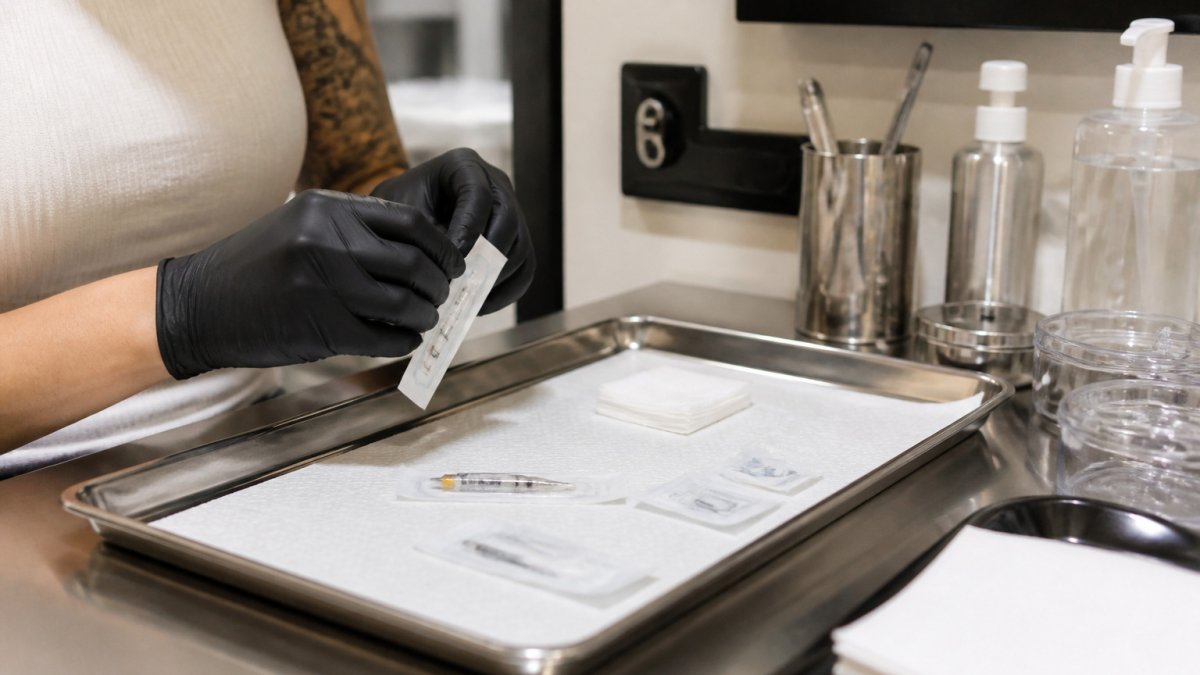
!Professional piercer preparing sterile single-use needles on a clean tray in a bright, tidy studio
Watch for these signs of a well-run studio:
- Sterile needles opened in front of you
- Clean, organized workstations and gloves changed between clients
- Clear written aftercare instructions
- Willingness to answer questions about procedures
If a studio is vague about any of these points, consider booking elsewhere. Hygiene is not a detail to compromise on, especially for placements that heal slowly.
3. Choose Placements That Are Easiest to Hide at Work
Some piercings disappear under normal workplace dress more easily than others. Inner cartilage piercings, such as a conch or inner tragus, sit close to the head and are typically covered by hair. Nostril and septum piercings can be subtle when worn with small, flat jewelry.
Placement is the first decision that shapes how visible a piercing will be. Choose a location that fits your job, your dress code, and your daily routine. Discuss this with your piercer before committing.
4. Use Clear and Flexible Retainers for Concealment
Jewelry choice matters just as much as placement. Clear or flexible retainers are a popular option for people who need a low-visibility look. Our Bioflex Labret Retainer in 16g with a 3mm ball is made from flexible Bioplast.

Retainers also suit the early stages of wear, when you may want to be more careful about visibility. Bear in mind that a piercing should be fully healed before switching to different jewelry, so plan your timeline around your work schedule.
5. Pick Jewelry That Suits Sensitive Ears
Sensitive skin is a common concern when choosing discreet jewelry. Materials matter. Our titanium options are implant-grade ASTM F136 titanium, and our 14K gold pieces are hallmarked by the UK Birmingham Assay Office. Browse flexible labret retainers for a comparison of sensitive-ear options.
Bioflex Labret Retainer 16G Clear Labret with 3mm Ball - Hypoallergenic Labret →
Look for clear labelling of material and gauge, and avoid jewelry where the metal is not specified. A material that suits one person may not suit another, so check how your skin responds during healing.
6. Ask the Right Questions During Your Consultation
A good consultation should cover more than price. Ask your piercer how they would position the piercing for concealment, what jewelry they recommend for the first weeks, and how long healing typically takes. Ask what aftercare involves and what signs of a problem to watch for.
Questions to bring with you:
- Which placements are easiest to conceal with my work clothing?
- What jewelry do you recommend while healing?
- How long before I can change to different jewelry?
- What aftercare products do you use or suggest?
Watch out: Do not assume a placement is hidden until you have checked how it looks with your actual work outfits.
7. Plan Healing Around Your Work Schedule
Healing takes time, and it can be more visible during the first weeks. Plan your appointment for a period when you can keep the area clean and avoid heavy physical contact. Many people book piercings before a holiday or a quieter stretch at work.
But the bigger issue most guides skip is this: the moment you most want to hide a piercing, the first weeks, is also the moment you should least interfere with it. Flipping, rotating, or swapping jewelry before a piercing is fully healed is one of the most common causes of irritation bumps, delayed healing, and infection. A clear retainer is not a free pass to change jewelry early.
Realistic healing timelines
Healing times vary by placement and by individual, but most practitioners work from broadly similar ranges:
- Earlobe: roughly 6 to 8 weeks
- Cartilage (helix, conch, flat, tragus): commonly 6 to 12 months, sometimes longer
- Nostril: often 4 to 6 months
- Septum: often 6 to 8 weeks, though full maturation can take longer
These are typical ranges, not promises. Cartilage in particular heals slowly because it has limited blood supply, and a discreet placement that sits under hair or a mask may be bumped more often than you expect.
Why early jewelry changes are risky
A healing piercing forms a delicate fistula, the channel of new tissue around the jewelry. Changing jewelry before that channel is stable can tear it, introduce bacteria, and restart the healing clock. Even a seemingly gentle swap to a clear retainer can cause trauma if the piercing is not ready. This is why a reputable piercer will usually advise against changing jewelry for concealment during the initial healing period, and will instead help you choose low-visibility jewelry from day one.
Aftercare that fits a work schedule
- Clean the piercing with sterile saline solution as directed, typically once or twice a day.
- Avoid touching the jewelry except with clean hands, and do not rotate it.
- Keep hair, masks, and clothing from catching on the piercing where possible.
- Do not use alcohol, hydrogen peroxide, or harsh soaps, which can slow healing.
- Watch for signs of infection, increasing pain, heat, swelling, or discharge, and contact your piercer or a medical professional if they appear (the NHS).
Planning around work
If your job involves physical contact, helmets, or tight uniform collars, book the piercing for a period when you can minimize friction on the area. A quieter stretch at work or a short break is often better than a busy season. And if your workplace policy is strict, confirm the rules before you book rather than after, a discreet placement is not the same as an invisible one, and a retainer may not satisfy every dress code.
Healing timelines vary by placement and individual. Discuss realistic expectations with your piercer rather than relying on general estimates. Keep your aftercare routine consistent and avoid changing jewelry before the piercing has fully healed.
Healing times differ by placement, so the table below sets out the typical ranges the article gives.
| Placement | Typical healing time | Note |
|---|---|---|
| Earlobe | 6 to 8 weeks | Usually the quickest to heal |
| Cartilage (helix, conch, flat, tragus) | 6 to 12 months | Sometimes longer; limited blood supply |
| Nostril | 4 to 6 months | Often a middle-range timeline |
| Septum | 6 to 8 weeks | Full maturation can take longer |
Frequently Asked Questions
What's the easiest piercing to hide?
Placements inside the ear and inside the nostril are usually the easiest to conceal. Helix, inner conch and tragus piercings sit within the ear's natural folds, and a nostril piercing can be hidden with a clear retainer or a small stud that sits flush. Discreet placement and full concealment are different things, though: a helix piercing can still be seen when hair is tied back, so check how a placement looks in your own workplace setting before committing.
How can I find a reputable professional piercer?
Look for a studio where the piercer is willing to explain their sterilization process and uses implant-grade jewelry such as ASTM F136 titanium or hallmarked 14k gold. A reputable piercer will also talk through healing expectations. Ask to see their portfolio and read recent reviews before you book.
What should I ask a piercer before booking a discreet piercing?
Ask how long the piercing typically takes to heal, which jewelry they will use at first and when you can switch to a retainer or a different stud. Ask whether they have experience with the specific placement you want and how they handle aftercare follow-up. You should also ask what happens if the piercing becomes irritated and whether the studio offers a follow-up check. Clear answers to these questions are a good sign of a careful, experienced piercer.
Can a new piercing be hidden safely while it heals?
Covering a fresh piercing is not recommended while it is healing, because trapped moisture and friction can slow healing and raise the risk of infection. A fresh piercing should be left uncovered and kept clean according to your piercer's aftercare instructions. Once fully healed, a flexible or clear retainer can be used to keep the jewelry low-profile, but only if your piercer confirms the piercing is ready for it.
